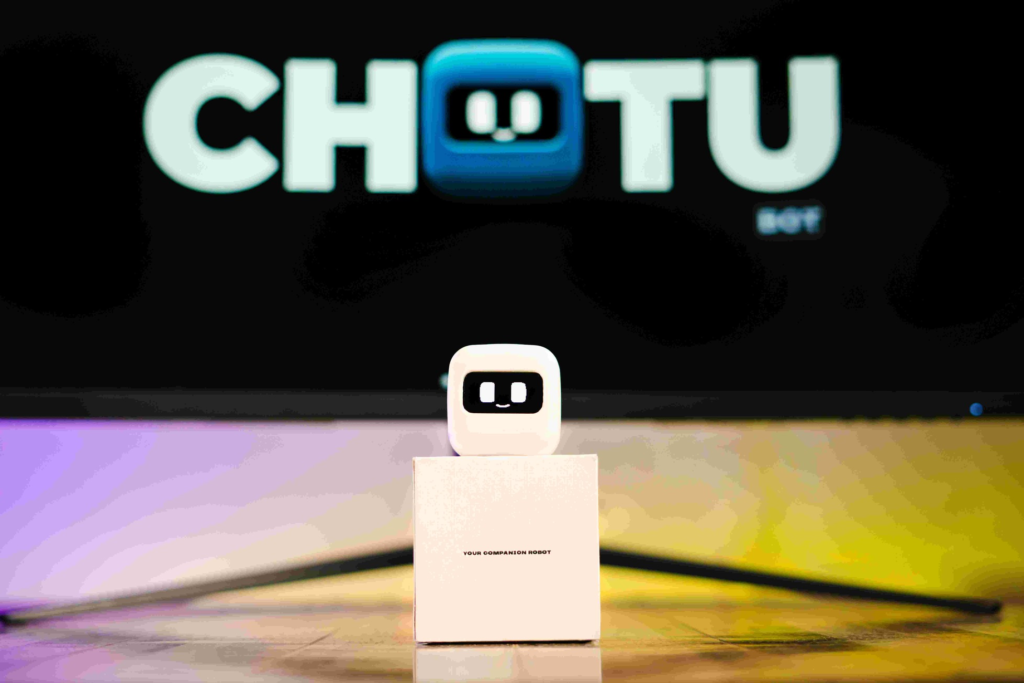
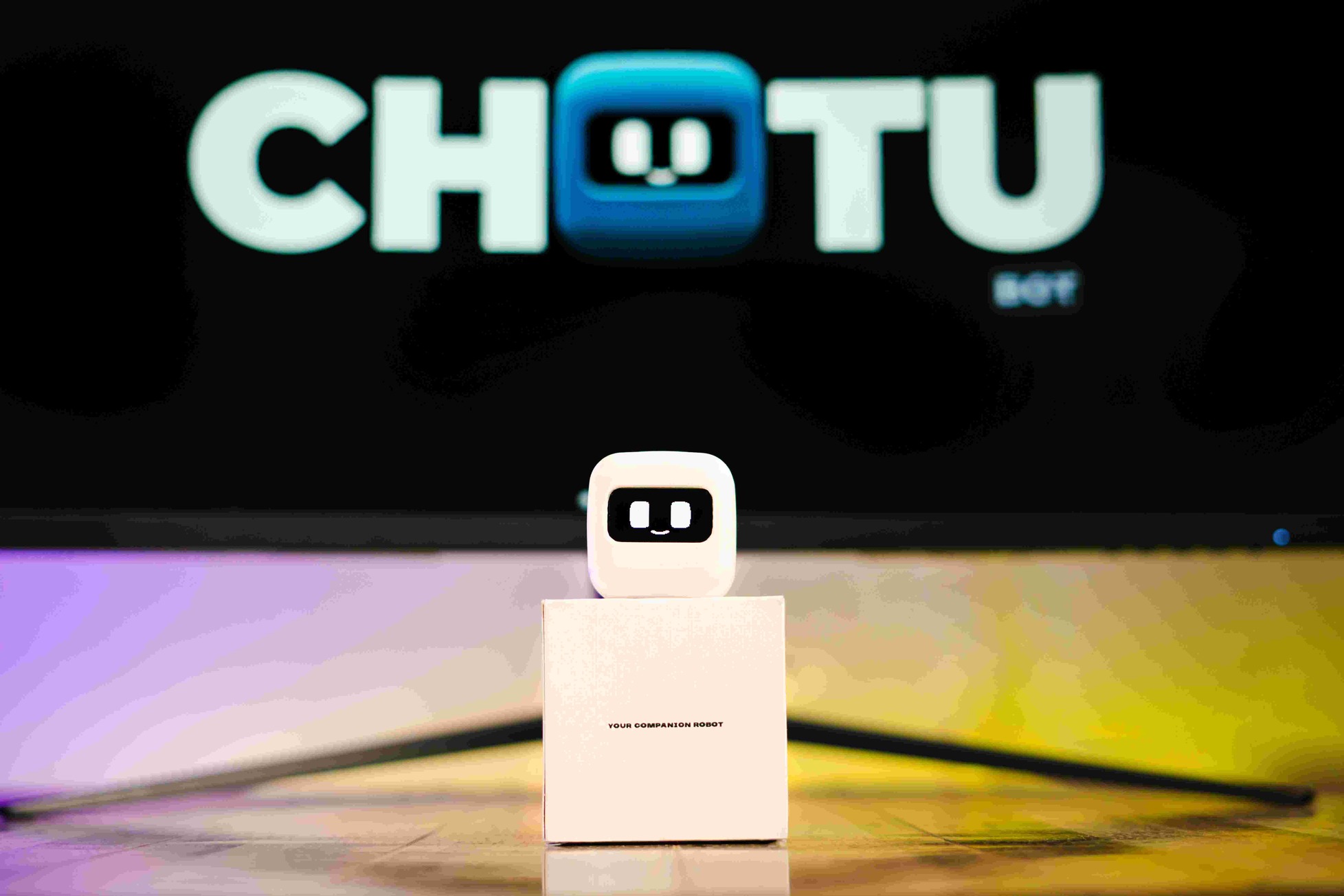
ChotuBot is a palm-sized ultra-compact desktop robot developed by an Indian robotics startup. As its name, “Chotu,” which means “small” in Hindi, suggests, ChotuBot’s tiny 5cm-square body moves around on the desk like a lovable digital pet with a life of its own.
Product Overview
The essence of this robot is not a mere “moving toy,” but a completely open-source design based on the ESP32 microcontroller, which comes standard with Wi-Fi and Bluetooth communication functions, allowing it to be operated directly from a smartphone or PC browser, as well as rewritten by the user himself. With its unique 3D-printed texture, it is highly regarded by engineers and students around the world with a DIY spirit as the “best introduction to robotics” at a low price, allowing them to learn about real robotics. It has been highly acclaimed by engineers and students around the world who are full of DIY spirit.
Summary of key points
What is ChotuBot?
- An educational/hobby robot from India: one of the world’s smallest robots, yet packed with authentic electronic construction elements.
- Powerful ESP32-based brains: Built-in powerful communication chip makes it very scalable as an IoT device.
- Product of the 3D printing community: Enclosure data is shared, making it easy to customize the appearance and replace parts.
- Unparalleled cost advantage: Starting from a few thousand yen, you can enjoy experimental programming without fear of failure.
good point
- Stunning space-saving design: It can be stationed in the corner of a desk or under a monitor without getting in the way at all, and can also function as interior decoration.
- Unlimited customizability: Supports Arduino IDE and MicroPython. You can directly experience the excitement of a working robot with your own code.
- Transparency of information: Schematics and source code are open to the public, and there is no black box, leading to in-depth technical learning.
- Global exchange: Users around the world publish their own “modified ChotuBot” on GitHub and SNS, which is very stimulating.
points of concern
- Hardware hurdle: The kit version requires very detailed work, so tweezers and soldering skills are essential.
- Language and information barrier: Much of the documentation is in English or Hindi, requiring search skills to solve problems in Japanese.
- Restrictions in the driving environment: Because of the small tires, even the slightest dust speck or desk joint can restrict movement, creating a delicate aspect of the vehicle.
Users who may be suitable for
- Programming learners: Beginners to intermediate who want to learn to control moving physical “objects” as well as on the screen.
- Gadget enthusiasts: those who want to create their own personal assistant that works with the latest AI (ChatGPT or Claude).
- Families enthusiastic about STEM education: Families who want to understand the fundamentals of how robots work by assembling them together with parents and children.
rough conclusion
ChotuBot is a canvas for “curiosity about the latest technology” to take shape, the smallest and strongest learning robot that packs future possibilities into the palm of your hand.
Frequently Asked Questions (FAQ)
We have compiled a list of questions that many users have before purchasing, along with detailed answers.
- What is the price range?: The cheapest DIY kits start at about ¥1,500, and the finished models (₹3999) are reasonably priced at around ¥7,300.
- What exactly can it do? The system can be programmed for: radio-controlled operation, automatic obstacle avoidance, emotional expression through LEDs, and unlimited automation through programming.
- Which operating systems are supported?: Browser-based UI allows control via Wi-Fi whether Windows, Mac, iOS, or Android.
- Are there any disadvantages? The chassis is not strong enough, and additional modifications are required for voice interaction, as it is not equipped with a speaker as standard.
- Are there software updates? Yes: The developer and community update the code frequently, and the latest features can always be introduced from GitHub.
What is the price range?
The basic DIY kit version starts at a surprisingly low price of about 799 rupees (about 1,500 Japanese yen) in India. The price of a complete full set, **₹3999, is around 7,300 Japanese yen (1 rupee = 1.82 yen)**, which is a very easy price range to introduce for a full-fledged programming robot. Even if imported from Japan, it can be fully enjoyed with a budget of less than 10,000 yen.
What exactly can you do?
Standard functions include “manual radio control operation” through a dedicated application or web browser, “line following” using infrared sensors, and “collision prevention” using ultrasonic sensors, etc. Furthermore, by utilizing the processing power of the ESP32 and linking it with the API of the latest AI LLM (Claude, etc.), users themselves can add personalized behaviors such as “dance when commanded by voice.
What operating systems are supported?
Since ChotuBot itself works as a Wi-Fi access point or connects to home Wi-Fi, the operator can choose any device model as long as it can run a browser. For programming, the Arduino IDE, which is widely available for Windows and Mac, is commonly used.
Are there any disadvantages?
Since the main body is very lightweight and has a high center of gravity, it may lose its balance with an “oops” if it makes a sudden start or stop. Also, the 3D printed parts are vulnerable to heat and strong shocks, so care should be taken not to leave it in a car in the middle of summer or drop it from a high place.
Will the software be updated?
The official GitHub repository is continuously updated with bug fixes and performance improvements. In addition, there are many original firmwares “forked” (derived) by users around the world, and new ways of playing are being proposed every day, which is another attraction of open source software.
Specifications Summary
| (data) item | Contents | Detailed Remarks |
| main board | ESP32-WROOM-32 | Wi-Fi / Bluetooth 4.2 LE, dual core |
| Size | Approx. 50 × 50 × 60 mm | Extremely small, about the size of an egg |
| weight | Approx. 85g – 110g | Varies depending on components, very lightweight |
| driver (of a vehicle) | N20 gear motor x 2 | Powerful torque despite its small size |
| power (button on TV, etc.) | 3.7V lithium polymer battery | Supports charging via Micro USB or USB-C |
| programming | Arduino / MicroPython / Blockly | Wide range of languages for beginners and professionals |
| Sensors | Distance sensor / IR sensor | Detects the surrounding environment and supports autonomous driving |
| Manufacturer | ChotuBot Team | Volunteer development team based in India |

Reviews (Word of mouth)
Good Reviews
If you have a 3D printer, it’s fun to print your own parts and modify them! If you use it in a programming class, you’ll get a whole different kind of bite from your students.”
Great for teaching kids programming. It’s small and cute, so just moving it around on my desk is soothing. It’s a great educational kit, and best of all, it’s priced so you can buy another one if you make a mistake.”
It’s interesting to be able to move robots using AI prompts, and best of all, you can link it to Claude’s MCP (Model Context Protocol) to inexpensively experience the near-future of giving instructions via chat. It’s perfect material for an age where you don’t have to write code, just let the AI write the code and let it flow.”
The design blends in well with a minimalist desk setup. It’s a nice change of pace to move it around a bit during work time, circling the desk while avoiding obstacles. This is a desktop toy for adults.”
— [Instagram gadget reviewer]
Mid-term and dissatisfaction reviews
I bought an assembly kit, but I felt the instruction manual was mainly illustrated and lacked explanations of soldering tips and tricks. The parts are as small as a grain of rice, so you have to be careful not to lose them. I recommend the finished product for beginners.”
The setting for switching between Wi-Fi mode and wired mode is a bit of a hurdle for beginners. Also, the tires have a weak grip, so they sometimes spin around on slippery surfaces. You need to be creative and wrap a rubber ring around it or something.”
The battery life is shorter than expected, sometimes lasting less than an hour when actively running. It would have been perfect if there had been a dock that would allow the device to run on a constant power supply. However, considering the size of the device, it might be reasonable.”
— [International EC site, review section].
comprehensive evaluation
ChotuBot is a robot that specializes in “creation” and “experimentation” rather than practicality. It is not for those who seek the experience of a finished consumer electronics product, but for those who want to bring a machine to life with their own hands and pursue the fun of changing its behavior with a single line of code. It is the best asset that can be found anywhere. Inexpensive yet highly compatible with the latest AI technology, it has the profound potential to continue evolving from “just a toy” to “a smart buddy” depending on the user’s skills.
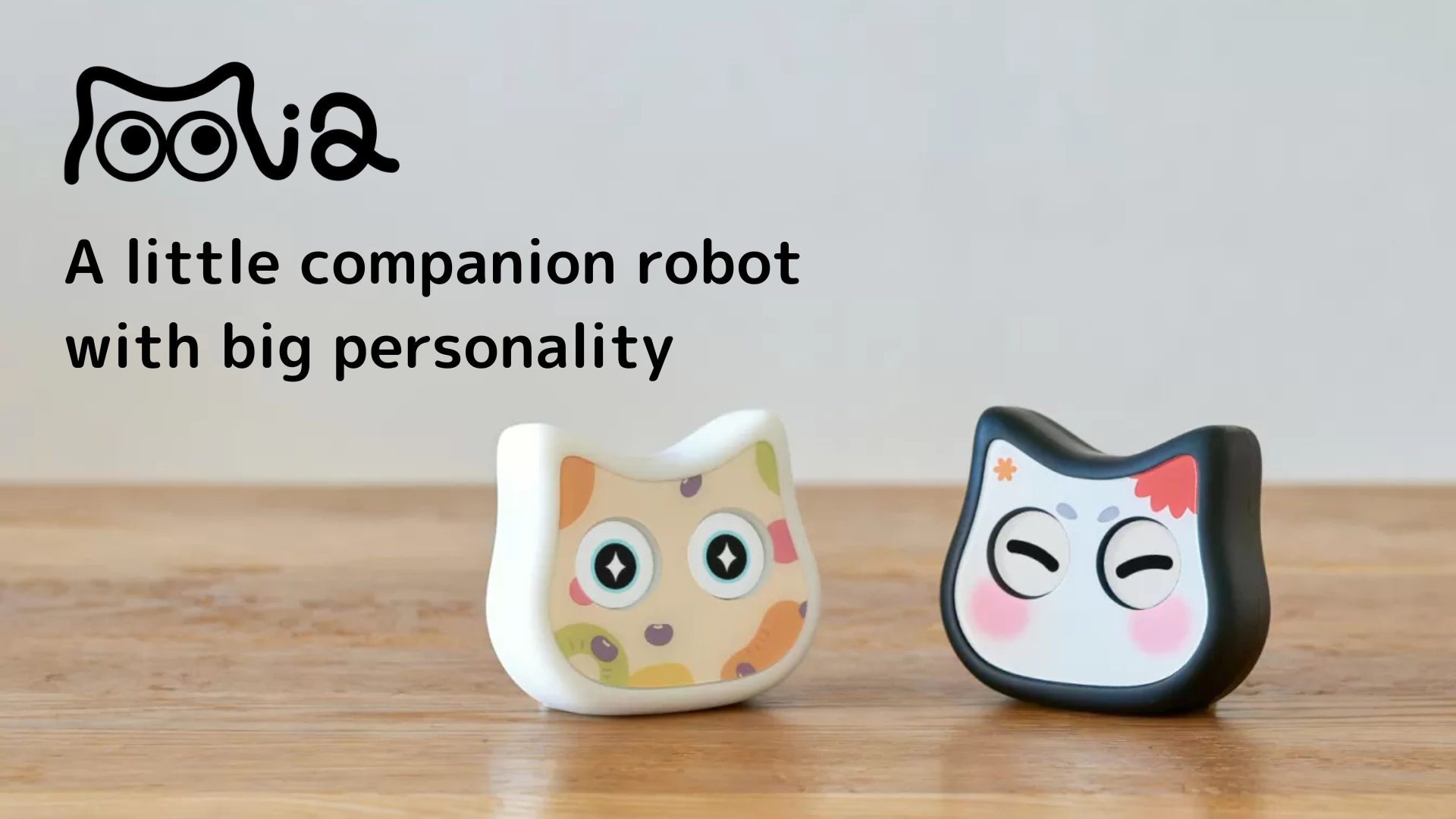
Comparison with “Mia,” a talking cat-shaped robot
We compared ChotuBot with Mia, an AI pet robot from Japan with a completely different personality.
| Comparison items | ChotuBot | Mia |
| appearance | Inorganic, mechanical, cyber impression | Warm design with cat motif |
| Main applications | Programming learning, DIY, electronics | Spiritual healing, daily conversation, dialect dialogue |
| Price | Very inexpensive (from several thousand yen) | Tens of thousands of yen (with advanced speech recognition and synthesis) |
| operation | Motor-driven and actively moving | Stationary, reacting with LCD facial expressions and voice |
| interactive function | Limited (user builds and expands) | Natural dialogue in the standard 47 prefectural dialects |
| customize | Deep modification of both hard and soft aspects is possible | Focus on setting changes and personalization of personality |
| target | Engineers, students, hobby users | All generations, families and single people seeking healing |
Key points of comparison: Mia emphasizes “warmth that accompanies daily life. It is a suitable choice for those who wish to easily incorporate the unique Japanese dialect of storytelling, daily healing, and familiarity.
👇 Talking cat-shaped robot “Mia” that speaks 47 dialects nationwide
summary
ChotuBot is a product that stimulates your instinct as a maker (creator) to convert your ideas into physical movement. No other existence is as easy and profound as ChotuBot as a platform for learning the basics of the latest AI programming and IoT, rather than simply watching it move. Invite the world’s smallest intellectual curiosity to your desk.
👀 Also read this article.
👉 [2026 Edition] 6 Latest Pet Robots to Heal Pet Losses – Thorough Comparison of Cat, Dog, and Healing Models
👉 [2026 Edition] Recommended pet robots for under 10,000 yen.
👉 [Latest in 2026] Thorough Comparison of Monthly and Maintenance Costs of Pet Robots – List of Running Costs of Popular Models including Moflin, LOVOT, Mia, etc.
👉What is Mia, an AI pet robot that speaks 47 dialects nationwide?