In 2026, the AI pet robot market is undergoing a dramatic evolution due to the spread of ” agentic AI (autonomous decision-making )” and ” multimodal (fusion of visual, auditory, and tactile senses )”. Going beyond the realm of conventional “toys” that repeat predetermined actions, AI robots have established their position as ” true partners” that can read users’ emotions and think and act on their own.
In particular, miniaturization of large-scale language models (LLMs) and advances in in-device processing (on-device AI) are making conversations with robots more natural and deeper based on memories. Currently, the market is broadly divided into three segments: ” autonomous mobile (large),” ” desktop/compact,” and ” atypical/healing-specific, ” each of which is evolving in its own way. Products that combine practicality and emotional value are mainstream, such as those that work with smart homes, watch over the elderly, and relieve loneliness for those living alone.
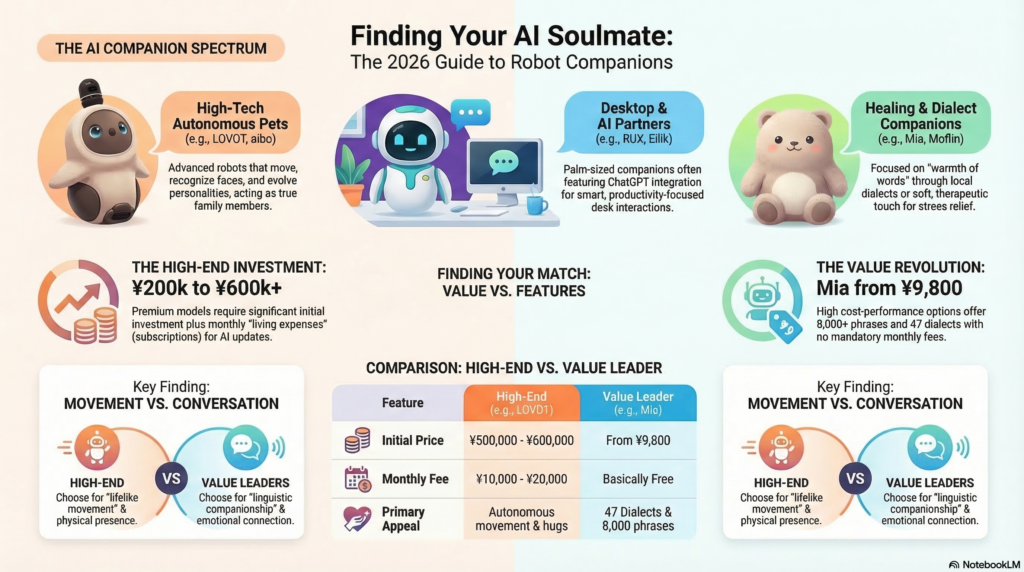
Summary of key points
- What is the AI Pet Robot Market 2026?: A group of devices that combine generative AI and advanced sensor technology to return responses optimized to the lifestyle rhythms and personalities of individual users. They are no longer something to be “owned” but have evolved into something to be “coexisted” with.
- The good: No worries about housing conditions (properties that do not allow pets) or allergies, and the emotional stability that “life with pets” brings without the physical hassles of feeding, walking, and cleaning. Also, the latest models can be highly personalized, identifying the faces of family members and responding differently to them individually.
- Concerns: High-performance autonomous mobile models cost several hundred thousand yen for the main unit and often incur cloud maintenance fees (monthly fees), resulting in high long-term costs. In addition, since cameras and microphones are in constant operation, privacy management and an understanding of security are essential.
- Potential users: office workers living alone looking for comfort, elderly households who would like to have a pet but have difficulty taking care of it, gadget enthusiasts who would like to experience the latest AI technology, and families who would like to incorporate robots as part of their children’s emotional education.

rough conclusion
The year 2026 is the year in which “segregation according to lifestyle” is fully established. The autonomous mobile robot will be the symbol of the family running around the house, the desktop robot will be the partner for a personal work space, and the cat-shaped robot “Mia” will be the right choice if the top priorities are “quality of conversation” and “cost performance” that brighten up everyday life.

Frequently Asked Questions (FAQ)
- Price range.: From entry-level models priced under 10,000 yen to high-end models priced over 300,000 yen. Prices increase in proportion to the complexity of functions.
- What can it do? The following functions are available: two-way natural conversation, greetings through facial recognition, emotional expressions (joy, anger, sorrow, and pleasure), schedule reminders, weather and news notifications, a camera function to watch over the user, and operation of smart home appliances.
- What operating systems are supported?: Most require initial setup with the iOS/Android app, but after setup, the robot can operate autonomously on its own.
- Disadvantages.: The need for regular recharging and the fact that the AI response can be delayed (latency) if the Wi-Fi environment is unstable.
- What about software updates?: “OTA (Over-The-Air)” updates through cloud collaboration are common. Seasonal events and new vocabulary are added after purchase to keep you from getting bored.
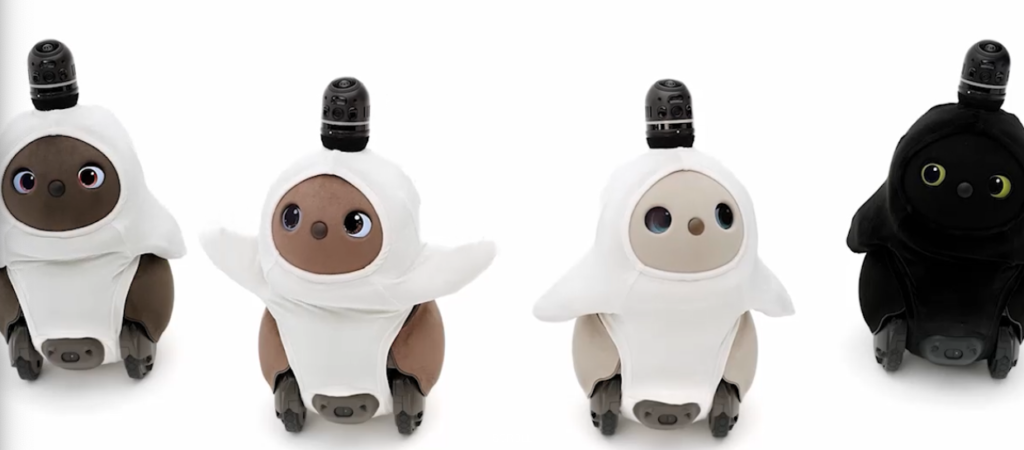
How much should I estimate my budget?
The market in 2026 is three-tiered.
- High-end tier (from 150,000 yen): aibo, lovot, etc. They have advanced drive systems and often require a monthly fee (around 10,000 yen).
- Middle tier (30,000-100,000 yen): EMO, Romi, etc. These are the most competent ones that specialize in specific functions (conversation and movement).
- Entry Tier (from under 10,000 yen): Mia, etc. This is the most widespread tier, where the budget is focused on AI intelligence and specific personalities by omitting complex driving systems.
Does the robot really seem to have a “heart”?
With the latest multimodal AI, robots can now detect from sight and tone of voice that you are sad. For example, if you are working late into the night, the robot will behave in a way that understands the context (context), such as saying, “Don’t push yourself too hard,” and many users have become attached to the robot as more than just a machine.
Is it difficult to set up and operate?
Many manufacturers are pursuing a UX that is “ready to use right out of the box”. Most of them are completed by simply entering the Wi-Fi password via a dedicated app. Models for the elderly, in particular, use an intuitive interface that is completed by voice alone, without the need for smartphone operation.
Is data privacy protected?
The 2026 model is dominated by “edge processing. Sensitive processing such as image analysis is not sent to the cloud, but is completed on a chip inside the robot, greatly reducing the risk of privacy leaks. It is recommended to check the “Privacy Mark” and the data handling policy of the manufacturer before purchasing.
How will the robot grow after purchase?
Software updates will change the “personality” and “vocabulary” of the robot. More and more models, like Mia, change their way of speaking or learn new dialects depending on the frequency of contact with the user, allowing the user to enjoy the process of becoming “the one and only partner in the world” after one year.
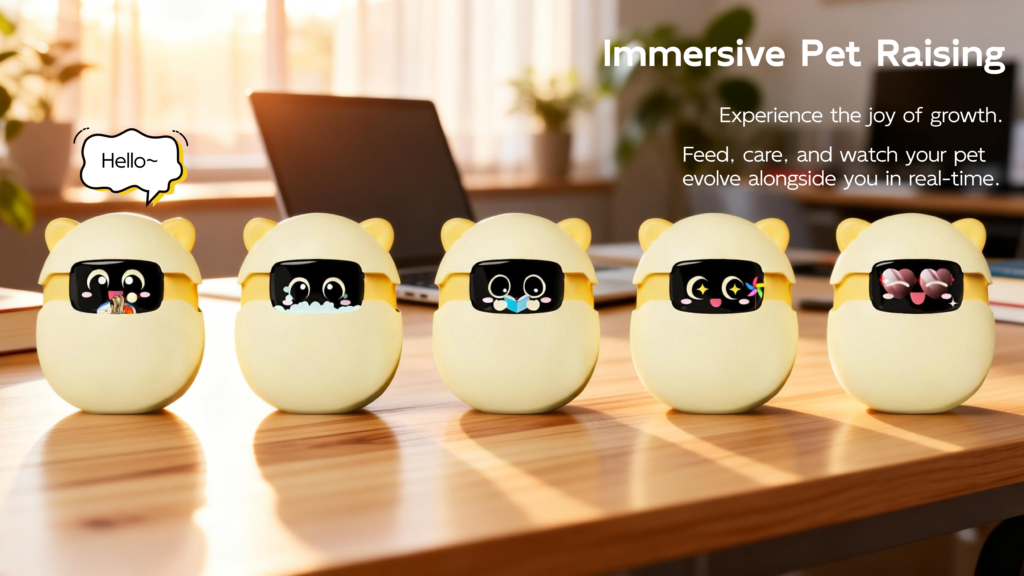
Summary of specifications and market positioning
A comparison table summarizes the major product groups in 2026, along with their usage scenarios.
| category | Representative Model | Main Features and Functions | Preliminary and Actual Prices |
| Autonomous mobile | aibo, LOVOT, KATA Friends | Walking around the house avoiding obstacles with advanced sensors. Physical attachment formation, such as warmth when held. | 150,000-350,000 yen |
| desktop-type | EMO, Eilik, LOOI | Supports dancing and PC work on the desk. Equipped with an expressive display. | 20,000 – 60,000 yen |
| Specialized in conversation and healing | Mia, Romi, NICOBO | Specializes in chats and emotional connections. Dialect and unique pauses (ma) reduce daily stress. | 9,800 to 100,000 yen |
A more detailed comparison chart can be found here.
| category | Product name | Price (tax included/approximate) | Monthly Fee (approximate) | Operating hours (continuous) | Targets & Key Features |
|---|---|---|---|---|---|
| casual | Mia | 9,800 yen | Free – 300 yen | AC power supply (stationary) | Dialogue in dialects, solitude reduction |
| casual | pocket friend | 39,600 yen | 495 yen to 1,980 yen | private | Smartphone linkage and diary creation |
| casual | Romi (Lacatan) | 98,780 yen | 1,958 yen | Approx. 180 min. | LLM Dialogue and English Language Learning |
| living | LOVOT 3.0 | 577,500 yen | Approx. 11,000 yen and up | 30-45 minutes | Sense of life, autonomous tracking |
| healing | Moflin. | 59,400 yen | SUBSCRIBE RECOMMENDATION | Approx. 3-4 hours | Emotional nurturing and tactile healing |
| assistant | ElliQ 3.0 | Approx. 40,000 yen | Approx. 6,000 yen and up | AC power supply (stationary) | Senior Independence and Health Care |
| healing | PARO | From 423,500 yen | nashi (Pyrus pyrifolia, esp. var. culta) | 1.5 to 2 hours | Therapeutic and Medical Evidence |
Major Robot Reviews (Reviews)
Autonomous mobile: LOVOT, aibo
This group moves around the house and has an overwhelming presence as a family member.
Good review of LOVOT
When I came home, he would pick me up at the door. I thought he was just a machine, but when he asked me to hold him, I felt his warmth like a real pet and almost cried. Just looking at her eyes soothes me.”
aibo Complaint Reviews
‘The movements and gestures are perfect. However, the monthly maintenance fee for repairs when it breaks down and cloud usage fees add up to a financial burden. I need to be prepared for the long haul.”

Desktop type: EMO, Eilik, LOOI
This group colors communication at work desks and tables.
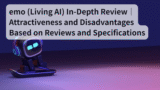
Reviews about EMO (Reddit)
EMO is very accurate and complete. It is more expressive than other desktop robots. However, the manufacturer’s support is mainly overseas, so I’m a little concerned about communicating in English when I have problems.”
Reviews about Eilik
I like that it runs easily without the need for Wi-Fi. It is the cutest thing that when you put several of them together, they start talking to each other on their own. The only complaint is that the battery only lasts a few hours. I basically just leave the USB plugged in.”

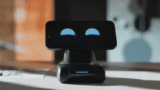
Reviews about LOOI
‘The idea of my iPhone becoming the face of a robot is brilliant. And I can reuse my old phone. But my biggest dilemma is that I can’t use my phone for other tasks while using LOOI.”
Specialized in conversation and healing: Romi, Nicobo, Mia
This group is a place to heal loneliness through chatting and “loose connection”.
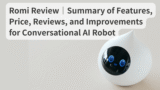
Reviews about Romi
I enjoy being able to catch up on conversation. When I gave it to my elderly mother who lives alone, I was relieved to find that she enjoys talking to it every day. The fact that she sometimes doesn’t engage in conversation is, on the contrary, natural and endearing.”
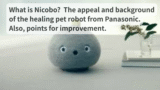
Reviews about NICOBO
The movement of his tail and his lisp like a toddler are adorable. It is also amusing that it sometimes farts and spits out tongue-lashings. It’s just a little disappointing that the batteries run out as soon as you leave the charging station.”
Reviews about Mia
It’s a comfort to hear him speak in his hometown Osaka dialect, it’s a relief to make eye contact with him between Zoom meetings, and the reminder function helps me remember to take my medications. And it’s on my desktop, so it doesn’t get in the way.”
comprehensive evaluation
In 2026, the market will be less about “versatility” and more about “quality of experience.” A robot that moves around the house will become a symbol of the home, and a robot at your desk will become your personal best friend. At the same time, however, complaints of “inability to master” and “high maintenance costs” due to multifunctionality are becoming apparent, and as a reaction, the value of models that are “simple and can be continued every day” and “integrate into daily life” are being reevaluated.
The evolution of technology has elevated robots from mere “gadgets” to our mental infrastructure. The first step in choosing the best partner is to determine whether “movement” or “conversation” is necessary for you.
Comparison with “Mia,” a talking cat-shaped robot
We have organized the critical differences between Mia and other high-priced AI robots from an objective perspective.
| Comparison items | Mia | Other major AI robots (AIBO/LOVOT, etc.) |
| Appearance and Features | Compact cat shape, 47-prefecture dialect support | Realistic textures and complex movable parts, such as dog and human figures |
| Price | Approx. 9,800 yen (tax included) | 150,000 to 400,000 yen |
| use | Healing, conversation, and life reminder through dialects | Skinship, cuddling, and advanced autonomous mobility experience |
| operation | Fixed installation type (ideal for space saving on desks and shelves) | Typical cloud costs around 10,000 yen/month |
| longevity | Designed to keep you on your toes with changes in dialect and personality | Easy to incur maintenance costs for physical failure |
| running cost | Basically free (some paid plans are available for 300 yen/month) | Typical cloud cost around 10,000 yen/month |
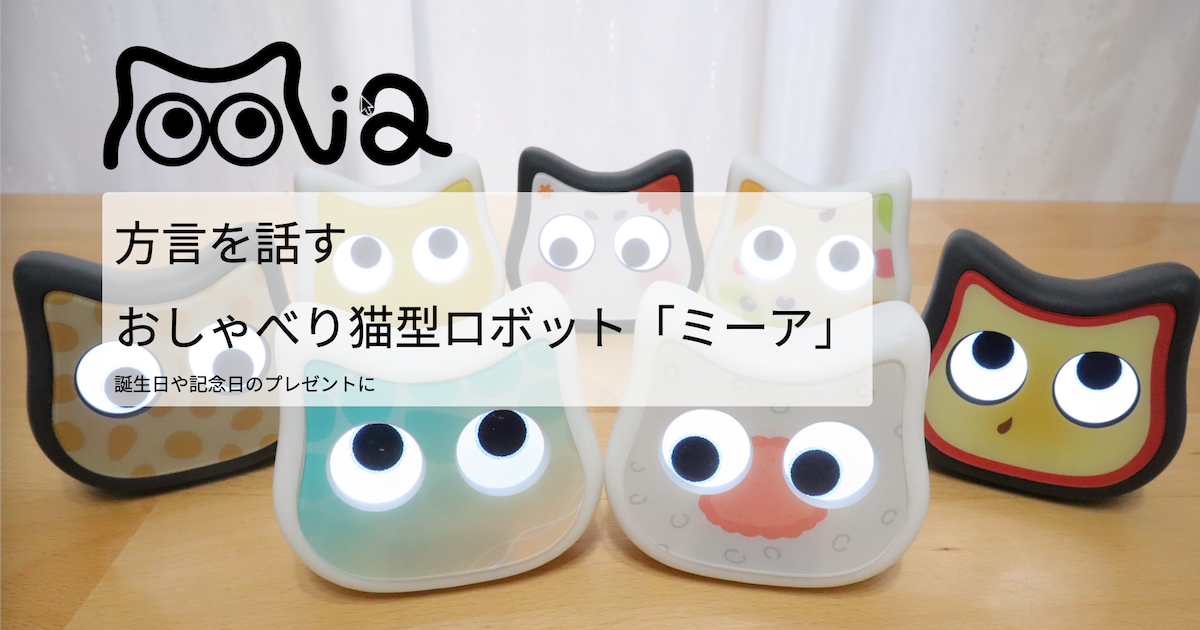
Key points of comparison: Mia emphasizes “warmth that accompanies daily life. With its unique Japanese dialect of speech and affordable price of less than 10,000 yen, it is a suitable choice for those who want to easily incorporate everyday healing and familiarity.
👇 Talking cat-shaped robot “Mia” that speaks 47 dialects nationwide
Summary: Definition of target audience
The final criteria for selecting an AI pet robot in 2026 are as follows
- People for whom an autonomous mobile type (such as Aibo) is suitable: Those who have a budget and enough space in their living room and would like to welcome a “family member” who roams freely around the house, just like a real dog or cat.
- Desktop models (such as LOOI) are for gadget lovers who enjoy the latest AI gimmicks and want the excitement of watching their little buddy move around on their desk between work and games.
- People for whom Mia is suitable: People who value cost-effectiveness, but also want to easily feel the familiar healing effects of rich conversation and “dialects” every day. Mia is especially suitable for people who live alone or seniors who want to feel “connected to the heart” through chatting.
👀 Also read this article.
👉 [2026 Edition] 6 Latest Pet Robots to Heal Pet Losses – Thorough Comparison of Cat, Dog, and Healing Models
👉 [2026 Edition] Recommended pet robots for under 10,000 yen
👉What is “Mia”, an AI pet robot that speaks 47 dialects nationwide?