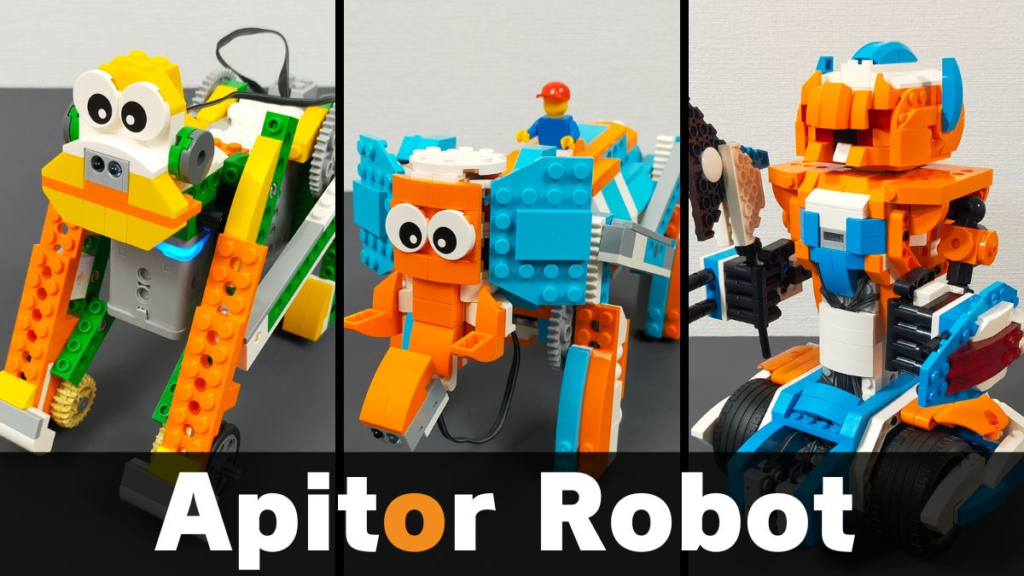
Apitor is a Lego-compatible block-type programming robot that has gained worldwide popularity. Its greatest feature is its unparalleled versatility, allowing a single kit to be reconfigured into several different types of robots, to more than 20 different types in higher-end models.
Product Overview
Using the dedicated ” Apitor Kit ” application, the robot can not only be remote-controlled from a smartphone or tablet, but can also be intuitively controlled even by beginners through Scratch 3.0-based visual programming. More than just a “moving toy,” Apitor Kit has attracted much attention in Japan as a tool for STEM education (Science, Technology, Engineering, and Mathematics) that fosters logical thinking.
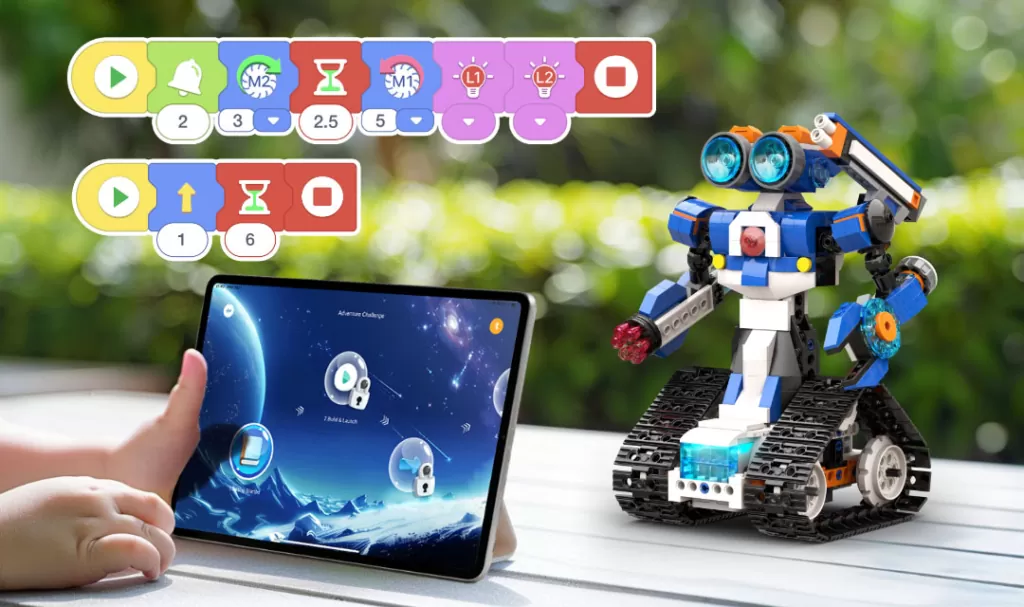
Children can experience both the “engineering” process of assembling blocks and the “programming” process of moving them as they wish, stimulating their creativity from multiple perspectives with a single machine.

Summary of key points
What is Apitor?
- Transformable: A single set can be used to create more than 10 to 20 different models (cars, dinosaurs, human figures, musical instruments, etc.) one after the other without getting bored.
- LEGO compatible: Uses industry-standard block standards. Can be combined with your existing LEGO bricks to expand into a one-of-a-kind original robot.
- App Linkage: iOS/Android compatible. The app plays the three roles of “assembly instructions,” “remote control,” and “programming environment.
good point
- Unparalleled cost performance: Can be introduced at less than half the price of other companies’ high-end robot kits with similar functions (e.g., LEGO Spike), in the 10,000-yen range.
- Step-by-step learnability: Smooth bridge from icon manipulation for toddlers to Scratch for elementary school students and up, to text code for more advanced users.
- A full range of sensors: infrared, color, and gyro sensors. You can create your own “intelligent behavior” such as avoiding obstacles or identifying colors.
points of concern
- Assembly difficulty: Each model can take several hours. Parental support is key to a successful experience, especially at first, as the parts are very detailed.
- Maintainability: Many models have battery boxes located deep within the structure, requiring partial disassembly each time the battery is replaced, a point that could be improved.
- Completely digital dependent: no paper instructions included, so a tablet device is required. Sight protection breaks rules need to be made.
Users who may be suitable for
- Parents who want their children to experience “beyond” block play: Those who want to teach them the joy of moving blocks, rather than just assembling them.
- Children who like to try things out on their own: The blocks’ ability to be rebuilt over and over again, even if they fail, fosters perseverance.
- Adults who prefer mechanical gadgets: In fact, it is a very profound “adult hobby,” and an increasing number of people enjoy it as a gadget on their desk.
rough conclusion
It is a seamless introduction to STEM education that provides a low-cost, authentic “moving and thinking” experience.
Frequently Asked Questions (FAQ)
- Price.: Depending on the model, about 7,900 yen to 16,900 yen (including tax).
- What can it do? The program includes: radio-controlled operation, automatic obstacle avoidance, line tracing, response to sound, and learning programming.
- What operating systems are supported?: Compatible with iOS 10 and above and Android 8 and above.
- Disadvantages.: It is difficult to sort the parts, and the batteries run out relatively quickly.
- Are there software updates? Yes: The application is updated regularly and new recipes and stability improvements continue to be made.
Q1: What are the differences in price ranges?
Apitor has several models, including “Robot Q,” “Robot S,” and “Robot X.” As the price increases, the “number of parts included,” “number of models available for assembly,” and “type and number of sensors” increase.
- Robot Q: An entry-level machine that emphasizes the fun of assembly.
- Robot S: Focus on balance. Equipped with a color sensor for more intelligent response.
- Robot X: Top-of-the-line model, with over 600 parts and 3 motors for the most complex deformations.
Q2. what kind of programming can I learn?
Visual programming based on “Scratch 3.0” developed by MIT is used. By connecting instruction blocks such as “If you hit a wall, turn right,” like a puzzle, users can naturally learn the basics of algorithms such as conditional branching and loop processing while playing.
Q3: What OS and connection methods are supported?
Connects to a smartphone or tablet using Bluetooth. All operations are performed from the dedicated “Apitor Kit” application. Especially when using the large screen of a tablet, the 3D assembly diagram becomes very easy to see, and work efficiency is dramatically improved.
Q4. are there any disadvantages or cautions?
The biggest disadvantage is battery replacement. Since the battery box is located at the heart of the robot, it is necessary to remove the exterior each time it is replaced. In addition, it is highly recommended to prepare a sorting case from a 100-yen store in advance, since it is easy to lose all parts if all parts are opened at once.
Q5. Are there any software or firmware updates?
The app is updated frequently through the App Store/Google Play. This stabilizes the connection, adds new models, and improves the UI, creating an environment that allows for long-lasting use.
Specifications Summary
The comparison will focus on the main models, Apitor Robot S and Robot X.
| (data) item | Robot S (Intermediate) | Robot X (Advanced) |
| Number of models assembled | 10 types | 12 types |
| Number of Blocks | 389 pcs. | 600 or more |
| sensor | Infrared x 2, Gyro, Color | Infrared x 1, Color x 1, Gyro |
| motor | High-speed motor x 2 pcs. | High-speed motor x 3 pcs. |
| power (button on TV, etc.) | AA battery x 3 pcs. | AA battery x 3 pcs. |
| Age Range | 7 years old and up | 8 years old and up |
| Main Features | STEAM education with art elements | Maximum Expansion and Power |
Reviews (Word of mouth)
We have thoroughly investigated honest reviews from users around the world.
General Review Links
- Kickstarter Supporters’ Comments (Development Stories and Hard Work)
- Reddit r/Robotics / r/STEM (technical discussions)
- Rakuten Ichiba Apitor Official Store Reviews (Domestic User Satisfaction)
- Amazon.co.jp Customer reviews (real thoughts from buyers)
Good Reviews
I was amazed at how focused my child was.” “I bought this for my 8 year old son for his birthday. At first it looked a little difficult, but he completed it on his own while spinning the illustration on the app. The moment the robot he built moved on his smartphone, he showed me a smile I had never seen before. Cospa is the best.” (Source: Rakuten Ichiba purchaser)
I bought this as a birthday present for my son who is now 7 years old and loves certain blocks.
First, he tried to assemble the robot one by himself, but he could not complete it even after a day’s work.
He loves blocks so much that he will continue to assemble it by himself without any hesitation.
Once disassembled, he tried to assemble the drill car that came with the instructions in the booklet. I found the parts and my son assembled it, and it took him a little over two hours.The assembly instructions, such as the length of the long stick parts, are quite confusing compared to the original. Also, some of the images were duplicated in the booklet.
However, the parts themselves are very elaborately made, and are on the same level as the original.It is very easy to work with the app and he is delighted to be able to control it with his phone.
It still seems difficult for a 7 year old to move it with code, but depending on parental suggestions and involvement, it could be interesting. (Like, let’s try to make a course and code it so it can run well on it.)It seems to be able to be reconfigured in several patterns, so it looks like it can be played with for a long time. I was able to purchase this product at a much lower price than the original, and I am satisfied with this quality. (Source: Amazon.co.jp user)
Neutral and Dissatisfied Reviews
Robot X was so good that we also purchased this Robot J. However, when we tried to run it on caterpillars, the axle came off the motor within a minute and it became impossible to run, and the child was not satisfied with the fun. I am not sure if it was due to vibration, rattling, or a problem with the way it was assembled.
I also thought about combining Robot X and Robot J to make a complex robot, but X and J have separate remote controls, so that kind of play seems impossible. However, if I had two smart phones, it would be possible for two people to operate each part and play with it.(Source: Amazon review )
“ The Bluetooth connection sometimes drops out, requiring a reboot. Also, because of its many functions, the battery drains quickly, and if you don’t use rechargeable batteries such as eneloop, the running cost is high.”
(Source: Kickstarter backers)
comprehensive evaluation
Apitor is a high-level fusion of “fun to build” and “intelligence to move. Despite its low price, Apitor has the potential to be “playable for a lifetime” due to the high accuracy of its sensors and the completeness of its application, and its compatibility with LEGO. On the other hand, it is a product that requires a certain degree of “parental support” in terms of inconvenience in replacing batteries and difficulty in managing parts. However, even with these factors taken into account, the educational benefits and sense of accomplishment gained are overwhelmingly superior to those of game consoles and toys in the same price range.
Comparison with “Mia,” a talking cat-shaped robot
Two robots with different personalities were compared from an objective point of view.
| Comparison items | Apitor | Mia |
| Appearance and Shape | Block mechanics (deformable) | Cat-shaped, stuffed animal-like (fixed) |
| Main Features | Assembly and Programming Learning | Talking and healing in dialect |
| price range | Around 10,000 yen and up | Around 30,000 yen |
| use | Education, Hobby, Logical Thinking | Family conversation, watching over the elderly, healing |
| operation | Running, deformation, sensor response | Response to voice calls, switching dialects |
| longevity | Prevent “boredom” by reconfiguring models | Deepen “attachment” through daily conversation |
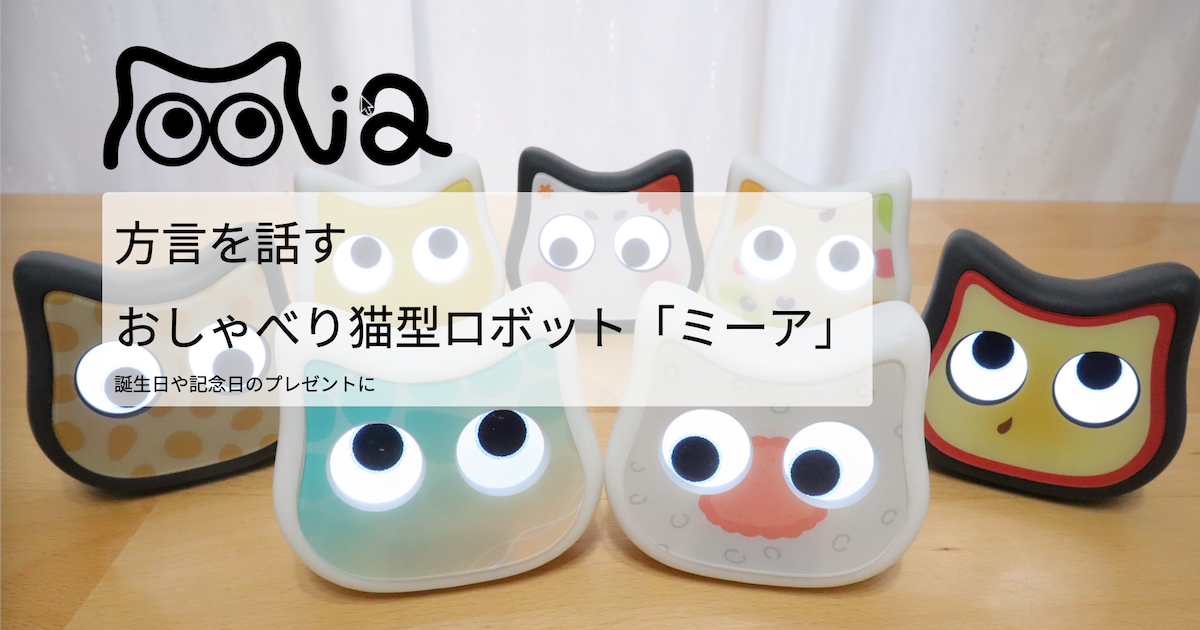
Key points of comparison: Mia emphasizes “warmth that accompanies daily life. With its unique Japanese dialect of speech and affordable price of less than 10,000 yen, it is a suitable choice for those who want to easily incorporate everyday healing and familiarity into their daily lives.
👇 Talking cat-shaped robot “Mia” that speaks 47 dialects nationwide
summary
Apitor can confidently recommend the following targets
- Children who love playing with blocks and want to take it to the next level
- Those who want to have fun preparing at home, as programming education is made compulsory.
- Creative people who enjoy their own unique inventions by repeatedly “breaking and building”.
Assembling blocks with unlimited possibilities and bringing them to life with their own programs. This experience will give children great confidence for their future.
👀 Also read this article.
👉 [2026 Edition] 6 Latest Pet Robots to Heal Pet Losses – Thorough Comparison of Cat, Dog, and Healing Models
👉 [2026 Edition] Recommended pet robots for under 10,000 yen.
👉 [Latest in 2026] Thorough Comparison of Monthly and Maintenance Costs of Pet Robots: List of Running Costs of Popular Models such as Moflin, LOVOT, Mia, etc.
👉What is Mia, an AI pet robot that speaks 47 dialects nationwide?