What Is Palmimo DevKit?
Palmimo DevKit is a tabletop AI robot development kit from Jizai Inc. Early access sales began on September 3, 2026.
Palmimo was previously introduced as "Mi-Mo" at CES 2025 and related events. The product name has since changed to Palmimo. The DevKit version is aimed at developers, researchers, companies, and institutions that want to run the robot with their own code.
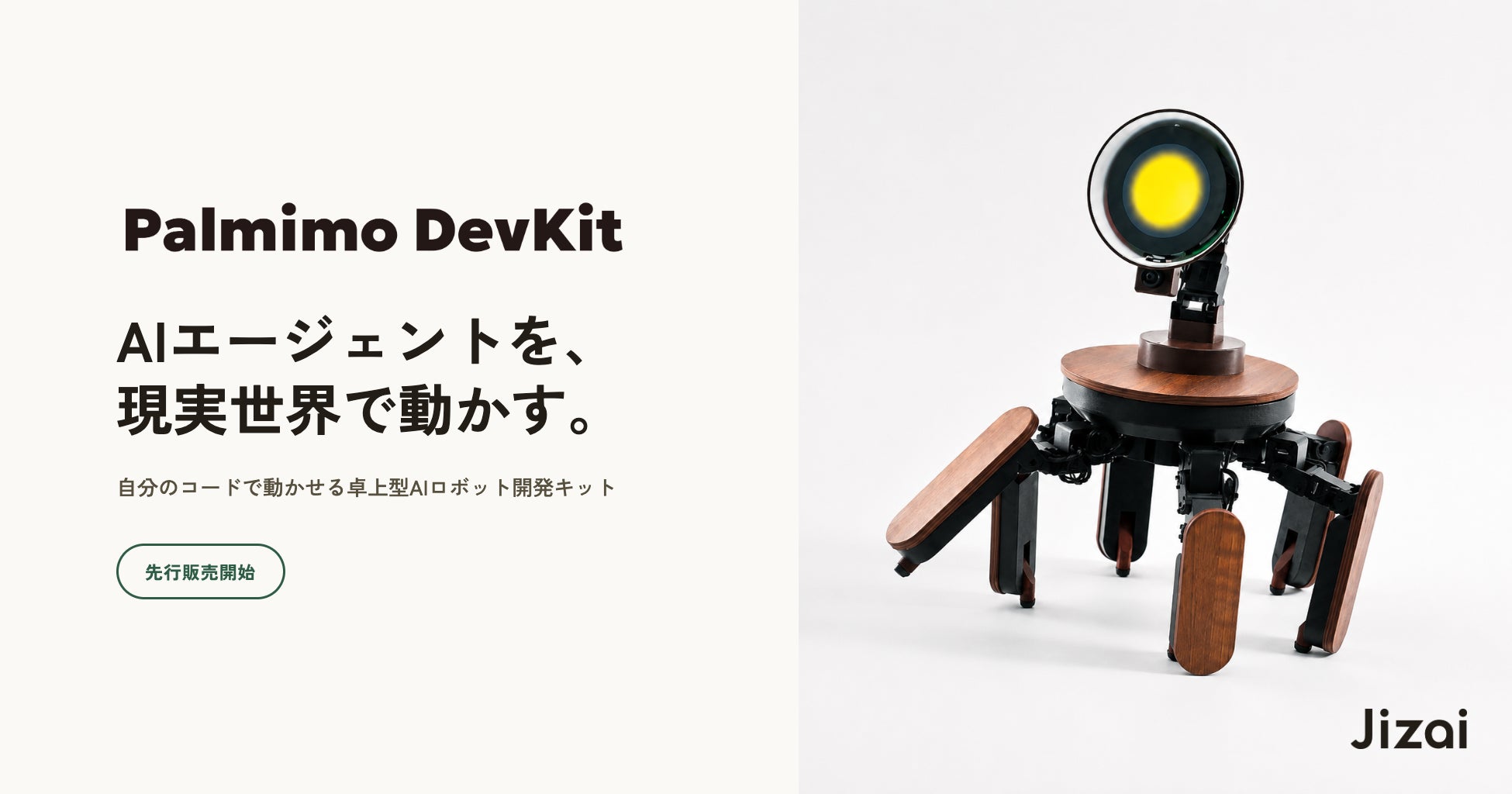
Image source: Jizai / PR TIMES
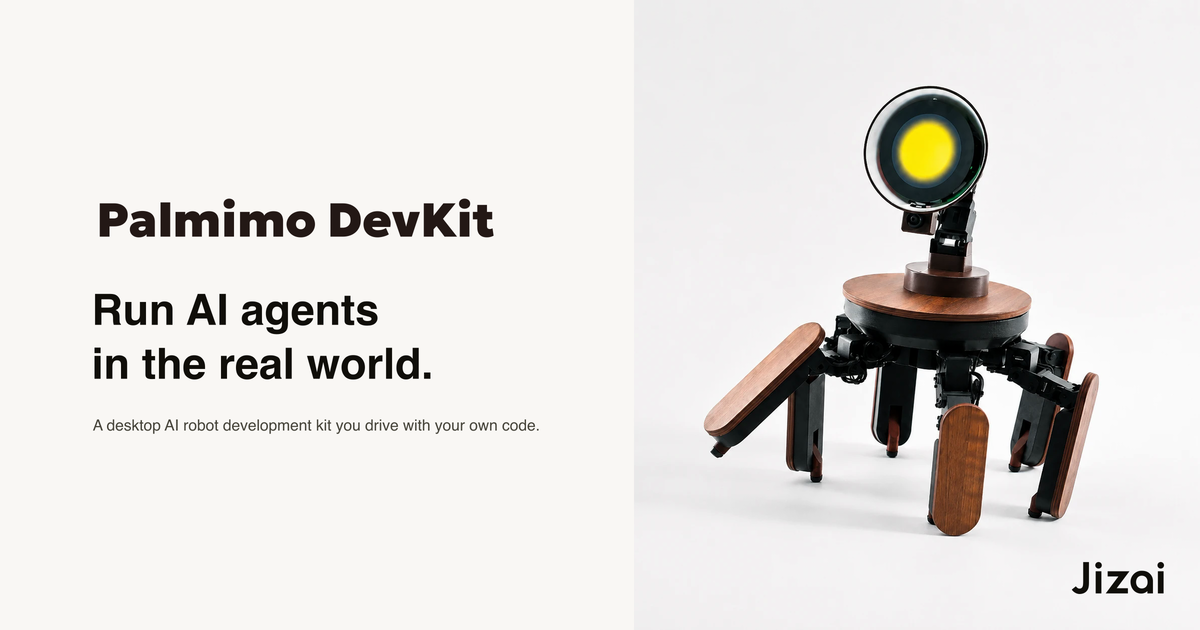
The important framing is that Palmimo DevKit is not a finished consumer pet robot. It is a platform for testing physical AI: AI agents that can see, listen, speak, display expressions, and move in the real world.
Jizai's Palmimo service page also describes Palmimo v0, a larger model measuring about 80 cm tall and weighing about 8 kg. The DevKit covered here is the compact tabletop version, measuring 400 x 300 x 300 mm and weighing about 2 kg.
Quick Summary
What is Palmimo DevKit?
- A tabletop development kit for Jizai's Palmimo robot, formerly known as Mi-Mo
- Offered first to Early Builders and Early Partners
- Early access price: 598,000 yen before tax, with no monthly fee
- 400 x 300 x 300 mm and about 2 kg
- 21 axes of motion: three axes for each of six legs, plus three neck axes
- Built around Raspberry Pi 5 16GB, a camera, microphone array, stereo speakers, and a 2.8-inch round touch display
- Designed to be controlled through Python SDK commands
- Intended to connect LLM tool calls to physical robot actions
- Software, including the SDK, drivers, and AI agent implementation, is planned for staged open-source release
What's good
- A clear Japanese entry in the physical AI developer robot category
- Python-based control lowers the entry barrier for software engineers
- Combines face, voice, camera, microphones, gestures, and movement in one physical platform
- GitHub and documentation are available for developers to inspect
- No monthly fee is listed for the early access unit
- Well suited for research, PoC work, workshops, exhibits, reception demos, and HRI experiments
What to watch out for
- At 598,000 yen before tax, it is expensive for ordinary home use
- It is aimed at developers and partner organizations, not general consumers
- Initial warranty is 30 days; longer support and care plans should be checked before purchase
- Some software and simulation resources are being released in stages, so buyers should confirm what is available at the time of purchase
- Specifications may change as the product improves
- Camera, microphone, and AI integration require careful privacy handling in offices, stores, schools, and public exhibits
Who it may suit
- Developers who want to test physical AI with a real robot
- Engineers connecting LLM tool calls to real-world actions
- Universities and labs studying human-robot interaction
- Companies running PoCs for reception, guidance, exhibits, training, or workspace interaction
- Teams looking for a robotics platform that can be approached from software first
Bottom Line
Palmimo DevKit is best understood as a serious tabletop robot for people who want to build with physical AI.
The price is high compared with consumer companion robots, but the product includes a moving 21-axis body, Raspberry Pi 5, camera, microphone array, speakers, round display, Python SDK, and AI agent implementation. For a lab, developer team, or corporate PoC, that is a clear package.
Its most interesting point is the connection between LLM tool calling and physical behavior. A chatbot can answer in text. A voice assistant can speak. Palmimo DevKit aims to let an AI agent turn, gesture, wave, walk, display expressions, and respond in the same physical space as the user.
That makes it very different from Mia. Mia is built for daily conversation, dialect voices, family use, and companionship. Palmimo DevKit is built for developers, researchers, and organizations that want to create new robot experiences.
Price, Availability, and Buying Notes
Early access price
Palmimo DevKit's early access price is 598,000 yen before tax. In Japan, that is 657,800 yen including 10% consumption tax.
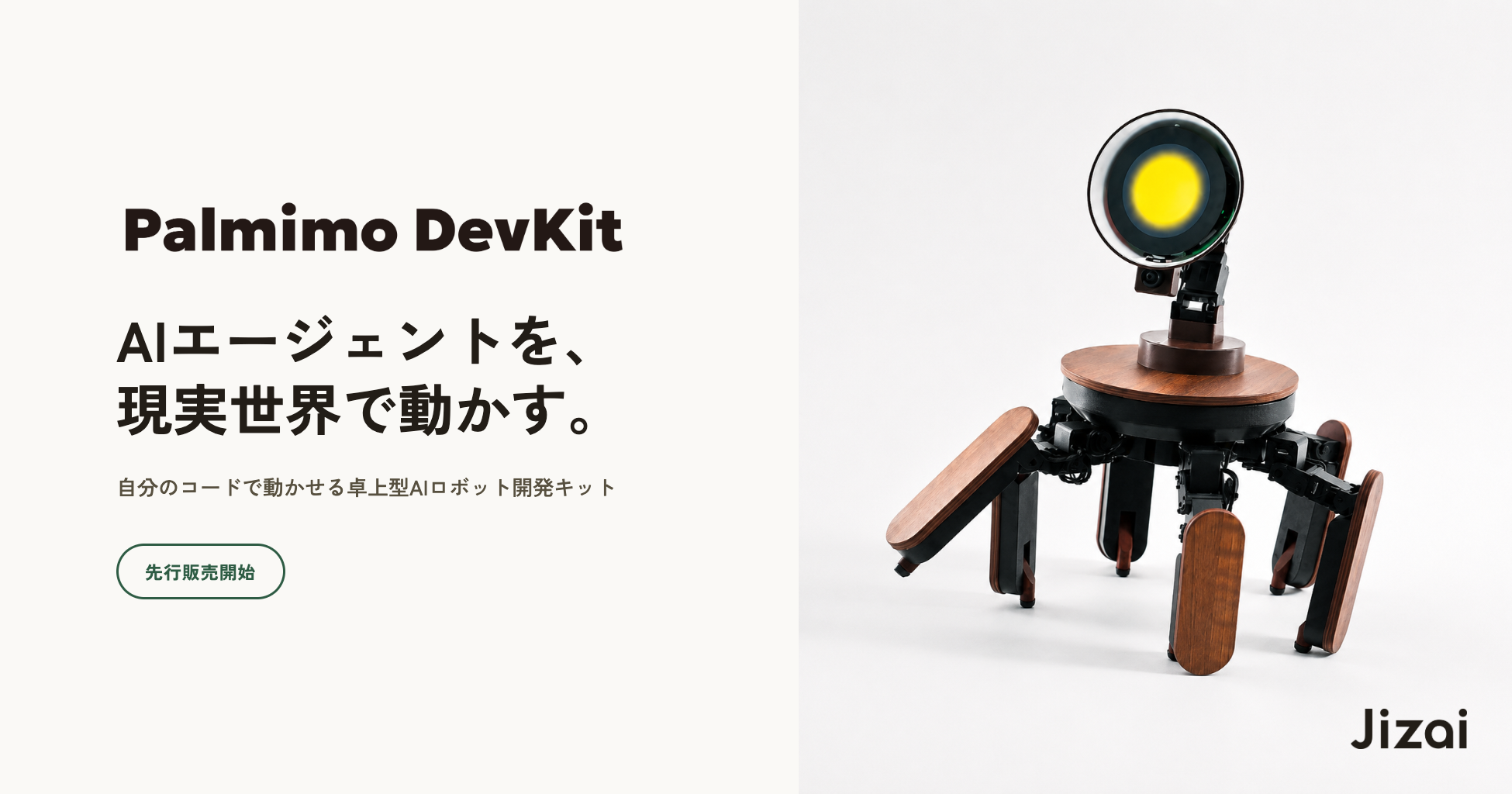
Jizai says the early access unit has no monthly fee. PoC support, custom development, training, and optional premium support are quoted separately depending on the scope.
This is not a casual gadget price. It makes more sense as research equipment, an R&D platform, a corporate PoC device, or a training tool for teams working on physical AI.
How to buy
Purchase requests are handled through the Palmimo DevKit official site.
The early access offer is aimed mainly at two groups:
- Early Builders: developers and researchers
- Early Partners: companies, service developers, research institutions, and PoC teams
This is closer to a consultation-led hardware purchase than a normal consumer e-commerce checkout.
Costs to confirm before purchase
Before buying, check the full operating cost and support conditions.
- Final tax-included price
- Shipping
- Delivery timing
- Warranty scope
- Palmimo Care Dev pricing and coverage
- Repair or replacement process
- Invoice and corporate purchasing support
- Training or onboarding costs
- Custom development scope
- Hardware documentation access
For companies and schools, the budget should include not only the robot itself, but also setup time, engineering ownership, privacy review, maintenance, and safety management during demos.
What Palmimo DevKit Can Do
Control a robot from Python
Palmimo DevKit is designed to let developers call robot actions from Python.
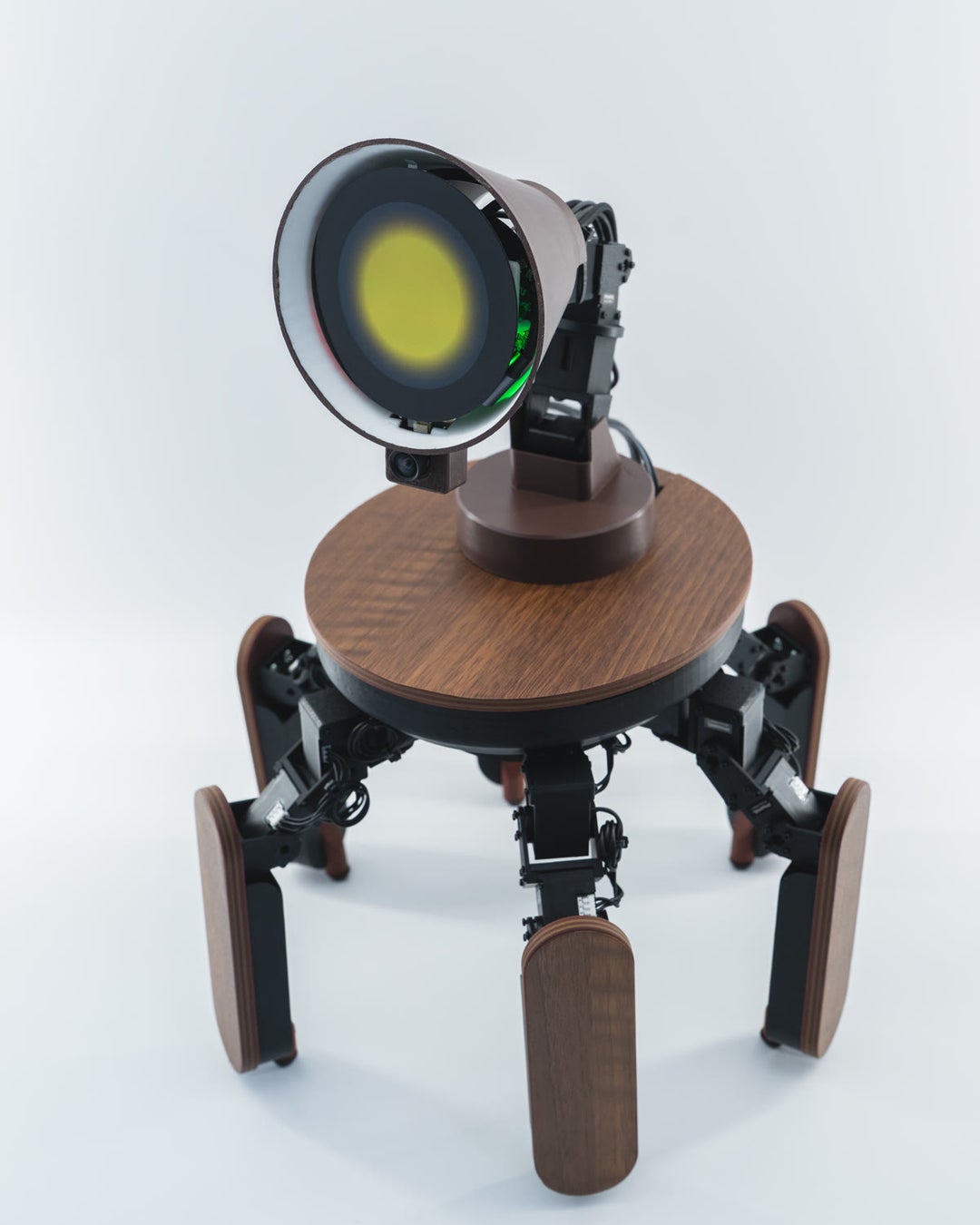
Image source: Jizai / PR TIMES

The official materials describe commands such as waving, walking, and turning the head. The goal is to let software engineers drive physical behavior without first becoming robotics specialists.
That matters because robotics usually requires knowledge of motors, sensors, posture, timing, communications, power, and safety. Palmimo DevKit wraps much of that behind an SDK so teams can focus on what the AI should do in the real world.
Connect LLM tool calls to physical actions
Palmimo DevKit includes an AI agent implementation that can connect LLM tool calls to robot actions.

Image source: Jizai / PR TIMES
This is one of the product's strongest ideas. Instead of stopping at "I understand," an AI agent can choose a physical action such as turning toward a person, waving, bowing, moving, or speaking with a matching expression.
Possible experiments include:
- Greeting visitors at a reception desk
- Turning toward the direction of a speaker
- Changing gestures based on conversation context
- Explaining exhibits in a physical space
- Connecting to internal systems for reception or FAQ workflows
- Comparing how different AI models behave in the same robot body
Palmimo DevKit is useful because it lets teams test what changes when an AI agent is not only on a screen, but physically present.
Human-robot interaction research
Palmimo is designed to meet people's eyes, react to voice, show expressions, and communicate through gestures. That makes it relevant for human-robot interaction research.
The same message can feel different when it is delivered only as voice versus when a robot also turns, pauses, changes posture, and looks back at the user. People read meaning from gaze, timing, distance, and movement.
Palmimo DevKit gives researchers and developers a compact way to explore those effects.
PoCs for offices, stores, exhibitions, and education
Jizai lists use cases such as offices, stores, exhibitions, education, healthcare, and care settings.
Because the DevKit is tabletop-sized, it is easier to place on a reception counter, exhibition table, classroom desk, or lab bench than a large humanoid robot. It can speak to visitors, respond with gestures, display a face, and connect to external data or systems.
For public or semi-public settings, teams should plan the following before deployment:
- How faces and voices are handled
- Whether recording is enabled
- Where personal data is stored
- What data is sent to cloud AI services
- How children and visitors may touch the robot
- How the robot is secured against falling
- How failures are handed over to a human staff member
An AI robot attracts attention, but privacy and safety design matter just as much as the demo.
Simulation and robot learning
Palmimo DevKit is also planned to support simulation and robot learning workflows. Jizai mentions simulation integration, Isaac Lab, CAD data, Sim2Real, and VLA fine-tuning.

Image source: Jizai / PR TIMES

This matters for research and education. Testing every behavior only on real hardware can cause wear, crashes, tuning cost, and downtime. A simulation workflow makes it easier to develop, validate, and then transfer behaviors to the real robot.
Buyers should still check which tools are already available and which are scheduled for later release.
Specifications
| Item | Details |
|---|---|
| Product | Palmimo DevKit |
| Company | Jizai Inc. |
| Former name | Mi-Mo |
| Availability | Early access sales began September 3, 2026 |
| Target buyers | Early Builders and Early Partners |
| Early price | 598,000 yen before tax |
| Monthly fee | None |
| Initial warranty | 30 days |
| Dimensions | 400 x 300 x 300 mm |
| Weight | About 2 kg |
| Degrees of freedom | 21 axes: six legs x three axes, plus three neck axes |
| Compute | Raspberry Pi 5 16GB |
| OS | Raspberry Pi OS 64-bit |
| Development language | Python 3.12+ |
| Display | 2.8-inch round touch display |
| Camera | 5 MP USB camera |
| Audio | Microphone array and stereo speakers |
| Connectivity | Wi-Fi, Bluetooth, USB |
| Main uses | AI agent experiments, HRI research, PoCs, education, robot learning |
| Official site | https://palmimo.dev/en |
Palmimo v0 vs Palmimo DevKit
Palmimo-related information can be confusing because Palmimo v0 and Palmimo DevKit are both mentioned.
Jizai's service page describes Palmimo v0 as a larger model around 80 cm tall, 45 cm wide, 45 cm deep, and about 8 kg. It is positioned around partner use and real-world demonstrations.
Palmimo DevKit is the compact tabletop development kit: 400 x 300 x 300 mm and about 2 kg.
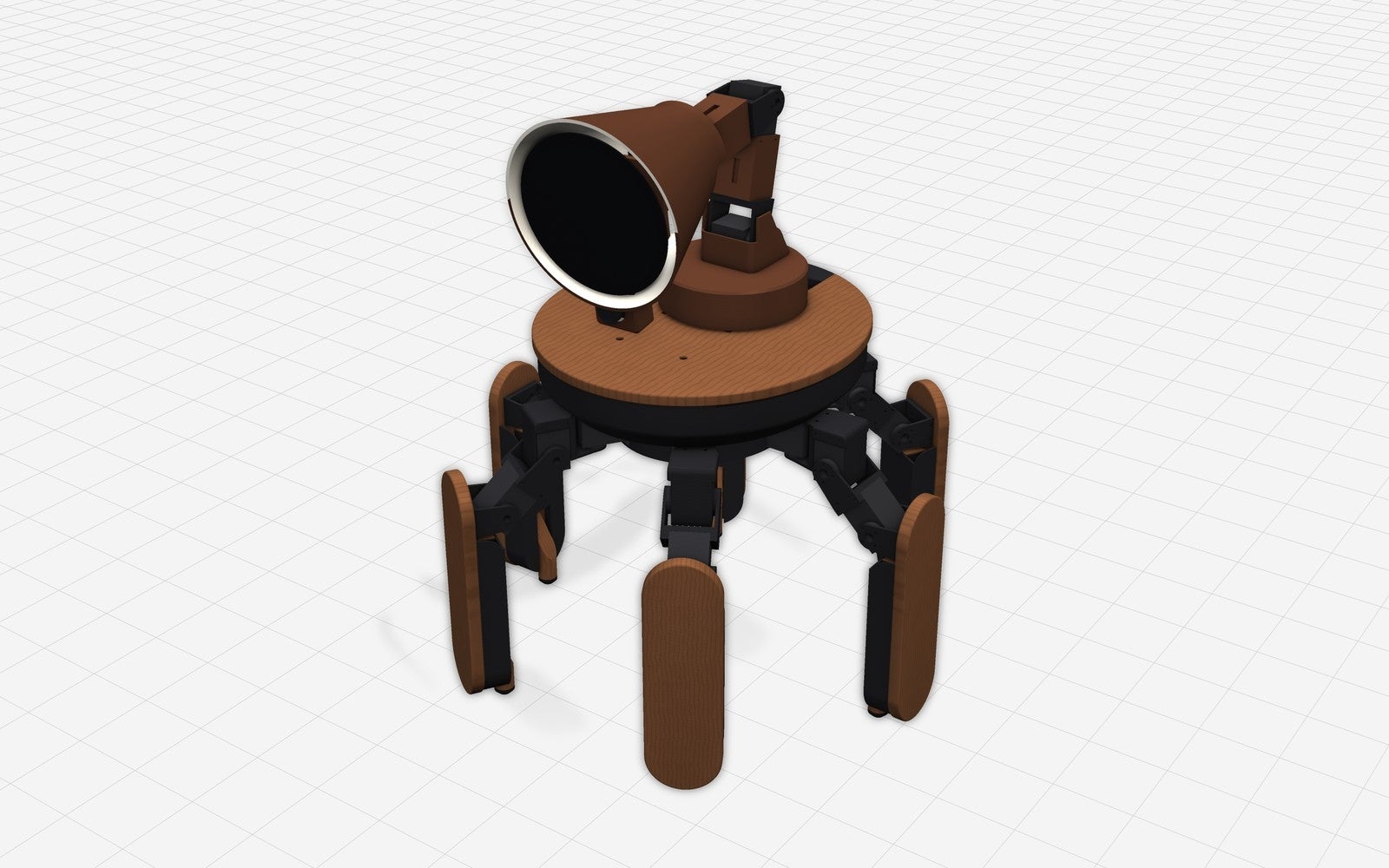
Image source: Jizai / PR TIMES
| Comparison | Palmimo v0 | Palmimo DevKit |
|---|---|---|
| Main role | Demonstration and partner model | Tabletop developer and research kit |
| Size | About 80 x 45 x 45 cm | 400 x 300 x 300 mm |
| Weight | About 8 kg | About 2 kg |
| Motion | Larger Palmimo body | 21-axis compact body |
| Price | More consultation-oriented | 598,000 yen before tax |
| Best for | PoC and partner deployment | Developers, labs, education, and early partners |
This article mainly covers Palmimo DevKit.
Buying Risks and Checks
It is not a consumer pet robot
Palmimo DevKit looks approachable, but its purpose is development, research, PoC work, and education.
People who simply want a robot for home companionship may not get enough value from it unless they also want to code and experiment.
The price is for serious development use
598,000 yen before tax is expensive for a hobby purchase.
For a corporate PoC or university lab, however, it can be viewed as a physical AI platform that combines a robot body, SDK, agent implementation, and future simulation tooling.
Check the software release status
Jizai says the software will be released as open source in stages.
Before purchase, check GitHub and the documentation for:
- SDK capabilities
- Sample code
- Supported AI models
- Tool calling examples
- Simulation environment status
- Hardware documentation access
- License terms
- Commercial and exhibition use conditions
Separate what is available now from what is planned.
Privacy and safety matter in demos
Palmimo DevKit includes a camera and microphone. In offices, stores, schools, and exhibitions, teams should decide how visitor faces, voices, and conversations are handled.
If cloud AI is used, check where data is sent, whether it is stored, how it can be deleted, and whether the workflow fits internal rules.
Early-lot hardware has early-lot risk
Early access hardware gives teams a chance to learn quickly, but documentation, tooling, examples, and support practices may still evolve.
Buyers should treat it less like a finished consumer device and more like a platform they will help shape through use and feedback.
Relationship to Existing Mia Articles
The Mia site has already mentioned Mi-Mo in CES 2025 overview articles.


Those articles introduced Mi-Mo as one robot among several CES products. They did not cover Palmimo DevKit's standalone price, specs, Python SDK, open-source plans, and purchase notes.
That makes Palmimo DevKit worth covering as a standalone follow-up article.
Palmimo DevKit vs Mia
Palmimo DevKit and Mia both make AI feel more tangible, but they are built for different jobs.
Palmimo DevKit is for developers and researchers who want to test embodied AI agents. Mia is a cat-like conversation robot for homes, family use, dialect voices, daily prompts, and companionship.
| Comparison | Palmimo DevKit | Mia |
|---|---|---|
| Form | Wood-accented tabletop multi-legged AI robot | Compact, friendly cat-like conversation robot |
| Main features | Python SDK, LLM tool calling, 21 axes, camera, microphone, open-source plans | 47 Japanese dialects, expressions, voice conversation, Google Calendar integration, weather updates, 15 English characters |
| Main purpose | Development, research, PoC, physical AI education | Companionship, daily conversation, family connection, gentle reminders |
| Target users | Developers, researchers, companies, schools | Families, older adults, children, gift buyers |
| Price | 598,000 yen before tax | From 9,800 yen including tax |
| Monthly fee | None listed for the DevKit | Depends on the selected plan |
| Developer focus | SDK, GitHub, documentation, AI agent implementation | Everyday conversation and character experience |
| Buying decision | R&D budget, PoC goals, development use | Home communication, companionship, and ease of use |
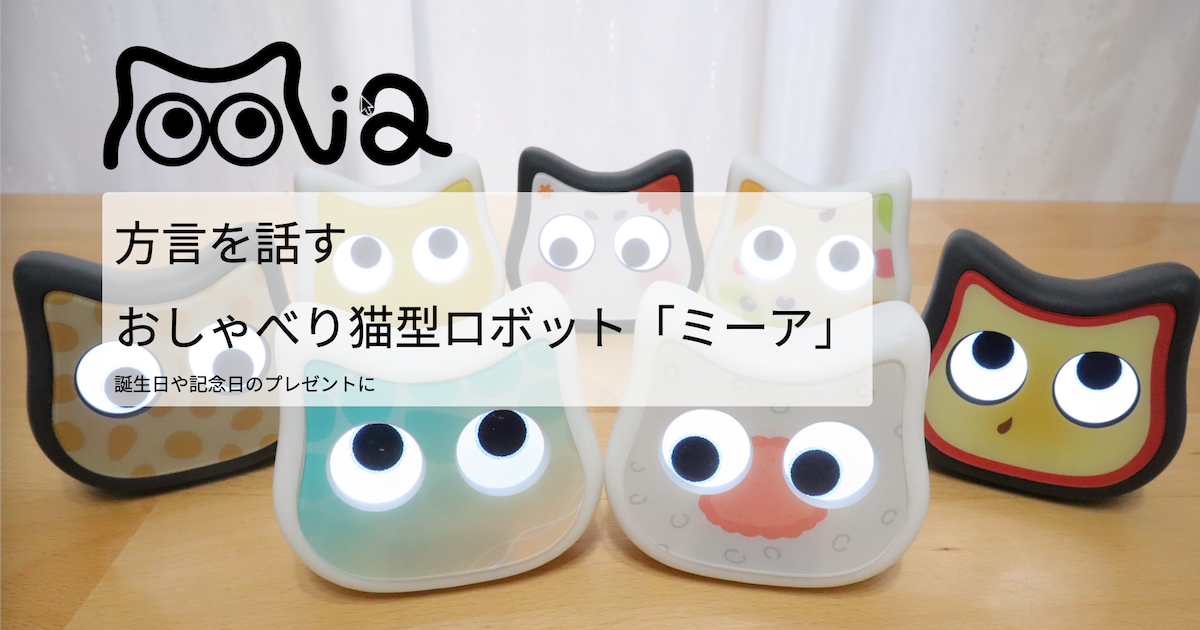
👇 Mia, the cat-like conversation robot that speaks 47 Japanese dialects
FAQ
How much does Palmimo DevKit cost?
The early access price is 598,000 yen before tax. With Japan's 10% consumption tax, that is 657,800 yen. Optional support, training, and custom development are quoted separately.
Are Palmimo and Mi-Mo the same robot?
Palmimo is the new name for Mi-Mo. Jizai changed the name in 2026. Older CES 2025 coverage may still refer to the robot as Mi-Mo.
Are Palmimo v0 and Palmimo DevKit the same?
They are related, but not the same size or offering. Palmimo v0 is the larger model described by Jizai's service page. Palmimo DevKit is the compact tabletop development kit.
Should ordinary households buy it?
Probably not unless someone in the household specifically wants to develop with robotics and AI. For companionship, conversation, gifts, or family communication, a consumer robot such as Mia, LOVOT, Romi, or Moflin is usually a more natural comparison.
Can programming beginners use it?
The Python SDK is designed to make the robot approachable, but the product still makes the most sense for people with some software experience or for use in a structured education setting.
Is it open source?
Jizai says it will release software in stages as open source, including the Python SDK, drivers, and AI agent implementation. Buyers should check GitHub and the official documentation for the latest release scope and license terms.
Overall Assessment
Palmimo DevKit is one of the more notable Japanese physical AI products to watch in 2026.
AI agents have mostly lived in screens, chat windows, voice assistants, and APIs. Palmimo DevKit gives developers a compact body for those agents: gaze, movement, gestures, expressions, and presence.
That does not make it a product for everyone. It is expensive, early, and useful mainly when there is a clear development, research, education, or PoC goal.
The right framing is:
- Important as AI robot news
- A natural follow-up to Mi-Mo's CES 2025 appearance
- A developer platform, not a consumer pet robot
- A useful contrast with Mia: building AI robots versus living with a conversation robot
Summary
Palmimo DevKit is Jizai's tabletop AI robot development kit for physical AI. It turns the former Mi-Mo concept into a concrete early access product for developers, researchers, companies, and institutions.
At 598,000 yen before tax, it is not a casual home robot. But as a package combining Python SDK control, LLM tool calling, a 21-axis body, Raspberry Pi 5, camera, audio, a round display, and open-source plans, it has a clear role.
For users who want daily conversation, dialect voices, family connection, or a gentle companion robot, Mia is the more relevant product. For teams that want to build the next generation of embodied AI applications, Palmimo DevKit is worth watching closely.
Palmimo DevKit is not for people who simply want to use an AI robot. It is for people who want to build what AI robots become next.
Related articles:
👉 The Future of Robotics Shown at CES 2025: 6 Notable Robots and Their Potential
👉 CES 2025 Elderly Care Robot Solutions: Robots Supporting Independence and the Future of Care
👉 2026 AI Pet Robot Market Map: Latest Trends, Major Models, and Price Comparison
👉 What Is Mia, the AI Pet Robot That Speaks 47 Japanese Dialects?
👀 You may also like:
👉 2026 Guide: AI Pet Robots for Elderly Loneliness – A Comparison of 10 Companion Robots
👉 2026 Edition: 9 Recommended Pet Robots Under $150 – Cheap, Cute, and Healing Models
👉 Monthly and Maintenance Costs of Pet Robots: Moflin, LOVOT, Mia, and More
👉 Mia – Your Chatty AI Cat Companion Robot with 100+ Expressions