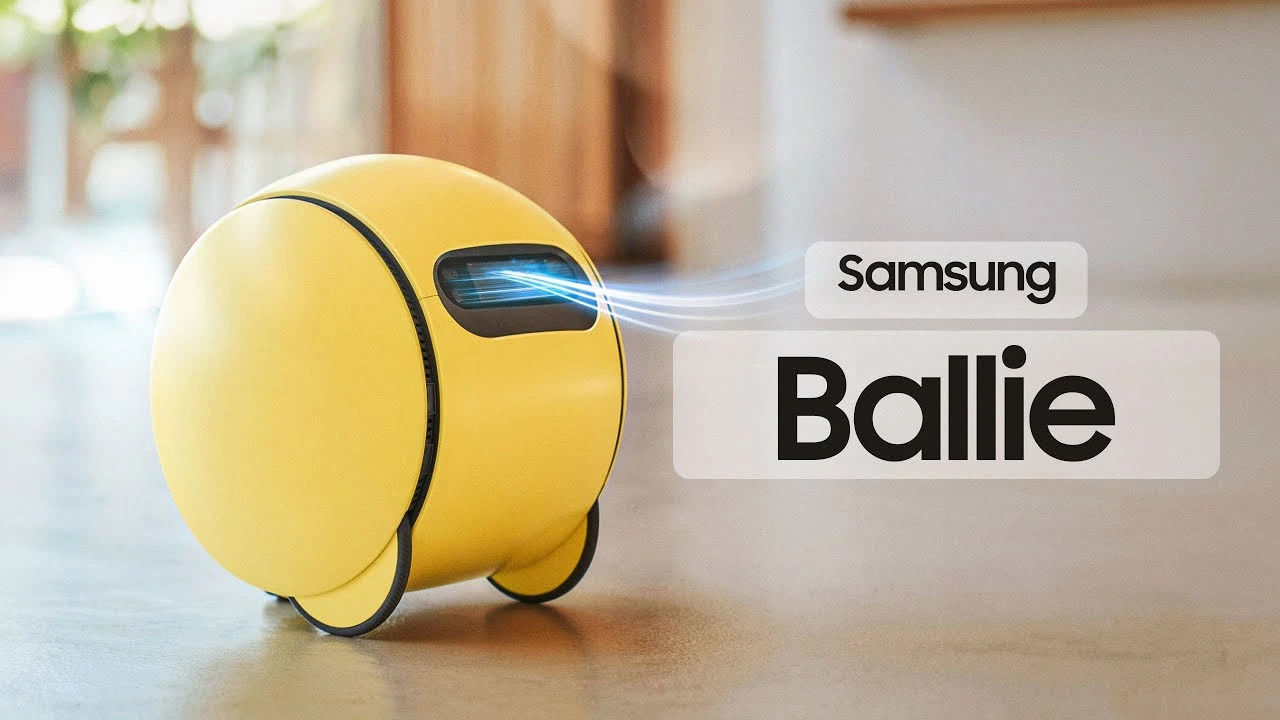
Ballie is an autonomous AI home agent developed by Samsung, one of the world’s largest consumer electronics manufacturers, and first unveiled at the 2020 CES (Consumer Electronics Show) as a tennis ball-sized concept model. It wowed gadget fans around the world! The first model was unveiled at CES (Consumer Electronics Show) in 2020. After several years of silence, it is back in the limelight at the 2024 CES with the latest generative AI technology and projector functionality, and has evolved to the size of a bowling ball.
Ballie Product Overview
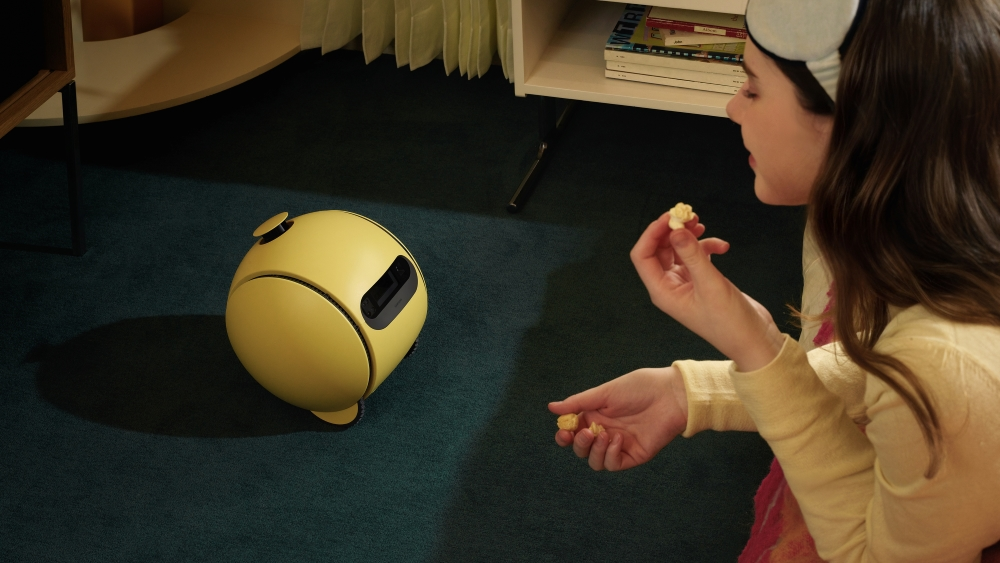
The main feature of this robot is the integration of spatial recognition AI and anintelligent projector built into the unit. Unlike conventional smart speakers or stationary robots, Ballie recognizes the user’s face, approaches on its own, and projects information onto the wall or floor at an optimal angle. Instead of “going to the device’s location,” Ballie provides an active user experience that only a mobile device can provide: “the device comes to you.
It also functions as a hub for Samsung’s powerful SmartThings home appliance integration platform, centrally managing all the smart appliances in the house, and learning the behavioral patterns of residents so that it can open the curtains when they wake up in the morning, care for pets while they are out, and even detect falls of elderly residents. It is designed to play the role of a “smart home command post,” like something out of a science fiction movie.

Ballie Summary of Key Points
What is Ballie?
- Moving AI Companion: A spherical robot that runs autonomously around the house and provides support based on user instructions and situations.
- Next generation interactive capability: Will be equipped with Google’s AI “Gemini”. Capable of requesting complex tasks through natural conversation.
- Moving Theater: Built-in 1080p projector. Everywhere becomes a screen, including walls, floors, and ceilings.
- The core of smart home: Integrated control of TVs, air conditioners, lighting, etc. through “SmartThings,” a home appliance coordination system.
good point
- Innovative projection experience: The system detects the user’s posture and eye level, and automatically projects an optimal image without distortion.
- Advanced Autonomous Patrol: Two front and rear cameras and LiDAR sensors allow smooth movement in the dark and through obstacles.
- Multimodal AI: Spontaneously makes suggestions based on understanding “what’s happening” from camera images as well as audio.
points of concern
- Uncertainty of launch: The U.S. and Korean launch was expected in summer 2025, but as of 2026, there are whispers of development delays in some parts of the world.
- Physical constraints: Due to its structure as a two-wheel drive sphere, the vehicle may get stuck on high bumps or on long-haired carpets.
- Privacy and reliability: Concerns about constant cameras circling the house. The robustness of the “Samsung Knox” security measure is key.
Users who may be suitable for
- Those who want a cutting-edge smart home experience: those who feel that existing stationary devices are not enough.
- Samsung/Galaxy users: The best true value is achieved in an environment where all smartphones and home appliances are made by Samsung.
- Busy working households and pet owners: Those who want to operate the robot from outside the house and check the detailed status of the house.
rough conclusion
A ‘willful’ mobile AI that understands your daily rhythms and turns your entire house into a movie theater or secretarial office.”
Ballie Frequently Asked Questions (FAQ)
- Price. Undecided, but expected to be around ¥150,000 to ¥250,000 due to the high-performance sensor and projector.
- What can it do? The following are some examples: monitoring, appliance operation, video projection, exercise coaching, and pet feeder operation on behalf of the pet.
- Which operating systems are supported?: Android (SmartThings app on Galaxy devices) is the main one.
- Disadvantages. Disadvantages include: inability to climb stairs and expensive installation costs.
What makes Ballie different from traditional smart speakers?
The greatest uniqueness lies in the combination of “mobility” and “projector”. While traditional speakers require the user to be within earshot, Ballie uses LiDAR sensors to map the house and actively locate the user. In addition, instead of having no screen, the system can project nearly 100 inches of video onto walls and ceilings, which means that the quality of visual feedback is overwhelmingly high.
What appliances can be connected?
Any device that supports Samsung’s SmartThings standard can be linked regardless of manufacturer. In 2024 and later models, support for the Matter standard is underway, enabling a wider range of smart home devices to be controlled. For more information, please get in touch with us.
How can I use it to watch over my pet?
Ballie can recognize pets with its front camera and stream their activities to the owner’s smartphone in real time. For example, if the pet looks bored, it can project a video of birds or fish on the wall for the pet to play with, or it can communicate with a smart automatic feeder to have food served at a set time. The system also has the ability to send alerts when it detects unusual behavior in pets.
Any plans for release in Japan or Japanese language support?
At this time, official announcements are prioritizing the U.S. and South Korea, and no release date has been announced for Japan. However, the AI engine (Gemini, etc.) that will be installed in the device has been developed to support multiple languages, so smooth Japanese language support is expected when the hardware is introduced to the Japanese market. The status of compliance with the latest regulations and the acquisition of technical conformity will be a key point in the future.
Ballie Spec Summary
| (data) item | Detailed specifications and contents |
| External dimensions | Approx. 20 cm in diameter (equivalent in size to a bowling ball) |
| Mobile Unit | 2-wheel drive, 360-degree in-situ turning, with autonomous avoidance system |
| Camera Systems | Front: 4K/30fps, Rear: 2K (for spatial understanding and gesture recognition) |
| projection function | 1080p Full HD resolution, automatic keystone and focus adjustment |
| Onboard AI | Google Gemini integration (multimodal processing support) |
| telecommunications standard | Wi-Fi 6E, Bluetooth 5.3, UWB(Ultra Wide Band) |
| sensor | LiDAR, ToF, 6-axis gyro, ultrasonic sensor for obstacle detection |
| battery | Continuous operating time 4-6 hours (varies depending on driving and projection conditions) |

Reviews (Word of mouth)
From hands-on reviews on Reddit, the world’s largest message board, and in the professional media, we have compiled a more multifaceted list of expectations and concerns about Ballie.
Positive evaluation: excitement about future life
The most impressive part of the CES demo was that when I sat down on the floor, Ballie instantly detected it, lowered its projection angle, and projected the image on the wall in front of me. It reacted as if it were alive, and it struck me that this was a true AI robot.”
(Source: Reddit – r/technology )
The Ballie’s design is far more futuristic and fits in with my decor, whereas Amazon’s Astro is more like a tablet with a screen. I find it very practical to have a projector so I can watch my workout videos anywhere in the house.”
(Source: YouTube – Tech Reviewer Comments )
Negative and cautious evaluation: points to realistic challenges
‘Samsung said the same thing in 2020. Will it really launch this time? The concept video is great, but I’m very skeptical that it will clear the messy floors, dropped toys, and high thresholds of a real home.”
(Source: Reddit – r/samsung )
If it were to cost close to $2,000, who would buy it? For the same budget, you could buy a top-of-the-line projector, a Roomba, and the latest iPad. The question is whether the ‘added value’ of being a robot is worth the price.”
(Source: Tech Forum – CNET Comments )
It’s a little creepy to have a camera constantly following me around.” I’m not comfortable putting it in my bedroom, considering the risk of being hacked. I think the lack of a physical camera shutter is a design error.”
(Source: Twitter – @PrivacyAdvocate )
comprehensive evaluation
Ballie is not just a “moving gadget,” but an “AI assistant with a physical body,” a new form of device for the post-smartphone era. Notably, Samsung has partnered with Google to incorporate a powerful LLM (Large Language Model) like Gemini. This enables advanced context-sensitive interaction, breaking through the limitations of conventional robots that can only understand fixed phrases.
However, as of 2026, it has not yet fully escaped the stage of being “a prototype with an extremely high degree of completion. In order for this robot to be widely used in homes, it is necessary to overcome the many steps that are common in Japanese houses, improve battery life, and above all, establish a definitive use case that makes people think, “This robot can only do what it can do. Nevertheless, this challenge to make the world of science fiction a reality has the impact of hastening the future of the smart home by several years.
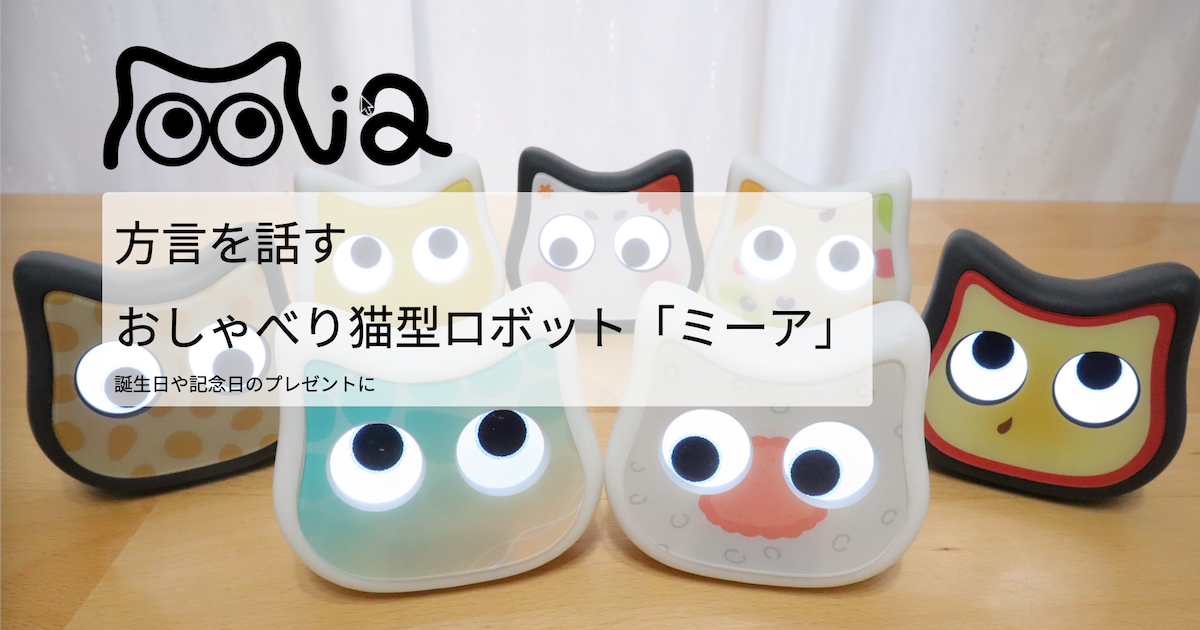
Comparison with “Mia,” a talking cat-shaped robot
We will objectively compare the feature-packed “Ballie” and the healing, conversation-focused “Mia” to find out which one fits your life better.
| Comparison items | Ballie | Mia |
| concept | Smart home command center and entertainment machine | Peace of mind and family communication |
| Main Functions | Projector projection, home appliance operation, autonomous driving | Dialect conversation, rich facial expressions, and singing in the dialects of 47 prefectures |
| familiarity | Inorganic, cool piece of technology | Plush warmth, cat-like gestures |
| Installation Cost | Expensive. Equivalent to high-end PCs and consumer electronics. | Reasonably priced from 9,800 yen (tax included). Perfect for yourself or as a gift! |
| maintenance | Requires sensor cleaning and complex software updates | Simple. Complete with only charging and app settings. |
| privacy | Always watch over the camera (surveillance aspect) | Mainly voice. High consideration for privacy. |
Key points of comparison: Mia emphasizes “warmth that accompanies daily life. With its unique Japanese dialect of speech and affordable price of less than 10,000 yen, it is a suitable choice for those who want to incorporate everyday healing and familiarity into their daily lives easily.
👇 Talking cat-shaped robot “Mia” that speaks 47 dialects nationwide
summary
Ballie couldn’t be more exciting for geeks who **”want to experience the latest technology before anyone else and master the art of making their entire home smarter**,” as well as for high-end users who love Samsung products.
On the other hand, if what you are looking for in a robot is not “advanced specifications,” but rather “a relaxing conversation when you come home tired” or “warmth to soothe your loneliness,” you may not necessarily need complex sensors and projectors. In that case, a partner-type robot like “Mia,” which speaks in dialect and snuggles up to you like family, would be more likely to fit deeply into your daily life and give you long-term satisfaction.
Is your ideal “life with robots” efficiency? Or is it healing?
Check the official website for the latest information:
https://news.samsung.com/us/samsung-ballie-ai-companion-robot-home-video-ces-2024
👀 Also read this article.
👉 [2026 Edition] 6 Latest Pet Robots to Heal Pet Losses – Thorough Comparison of Cat, Dog, and Healing Models
👉 [2026 Edition] Recommended pet robots for under 10,000 yen
👉What is “Mia”, an AI pet robot that speaks 47 dialects nationwide?