- AI Pet Robots Are Hard to Compare by Features Alone
- Quick Takeaway: Attachment Comes From Several Different Design Choices
- Comparison Table: AI Pet Robots by Attachment Style
- Voice and Conversation: Attachment Through Being Talked To
- Touch: Attachment Through Holding, Stroking, and Softness
- Movement: Attachment Through a Body That Acts on Its Own
- Growth and Memory: Attachment Through a Relationship That Accumulates
- Silence and Imperfection: Attachment Without Too Much Explanation
- Which Attachment Type Should You Choose?
- What Research Adds: Attachment Is Not Just Usefulness
- Summary: Choose by Relationship Design, Not Just Specs
AI Pet Robots Are Hard to Compare by Features Alone
When people compare AI pet robots and companion robots, they often start with price, subscription fees, cameras, conversational AI, battery life, app support, and hardware specs.
Those details matter. But they do not fully explain whether a robot will feel like something you want to keep near you.
For AI pets, the deeper question is this:
How does the robot create attachment?
A robot vacuum or smart speaker is easy to judge by usefulness. AI pet robots are different. They sit in your room, respond to you, make sounds, look at you, move, or invite touch. The real question is not only "What can it do?" but also "Will it feel comfortable to live with?"
This article compares AI pet robots not as a simple ranking, but by the design patterns that make people feel attachment: voice, touch, movement, expressions, growth, care, silence, and family connection.
It includes both Japanese and international examples: LOVOT, Moflin, aibo, PARO, Loona, ElliQ, Moxie, Tombot Jennie, Qoobo, and Mia (ミーア).

Quick Takeaway: Attachment Comes From Several Different Design Choices
AI pet robots do not all create attachment in the same way.
| Attachment cue | What the user experiences | Typical examples |
|---|---|---|
| Voice and conversation | Talking, hearing replies, receiving encouragement | Mia (ミーア), Romi, ElliQ, Moxie, Loona |
| Touch | Holding, stroking, feeling softness or warmth | Moflin, Qoobo, PARO, LOVOT, Tombot Jennie |
| Movement | Approaching, following, turning, moving through a room | LOVOT, aibo, Loona, EMO, Eilik |
| Eyes and expressions | Gaze, blinking, facial reactions, emotional cues | LOVOT, Mia (ミーア), Eilik, EMO, Loona |
| Growth and memory | Becoming familiar, changing personality, remembering preferences | aibo, Moflin, LOVOT, Loona, Moxie |
| Care | Charging, checking reactions, building small daily routines | aibo, LOVOT, Moflin, digital pets |
| Silence and ambiguity | Letting the user project emotion without too much explanation | Moflin, Qoobo, PARO |
| Family connection | Messages, reminders, check-ins, conversation starters | Mia (ミーア), BOCCO emo, ElliQ, Moxie |
This means the "smartest" robot is not always the best choice.
Some people want a robot that talks. Some prefer a quiet object they can hold. Some want a robot that moves like a pet. Others want a voice-first companion that supports daily routines.
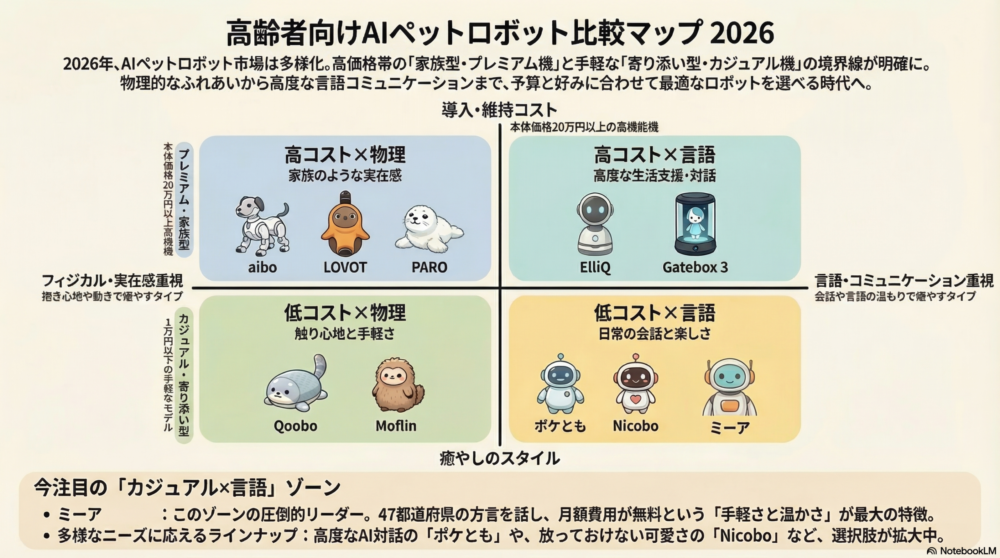
Comparison Table: AI Pet Robots by Attachment Style
| Product | Main attachment cues | Physical presence | Conversation | Touch | Mobility | Growth / memory | Best for |
|---|---|---|---|---|---|---|---|
| LOVOT | Eyes, warmth, movement, care | Strong | Limited | Strong | Yes | Yes | People who want a strong family-like presence |
| Moflin | Touch, sounds, growth, silence | Strong | No | Strong | No | Yes | People who want a quiet holdable AI pet |
| aibo | Dog-like movement, growth, memory | Strong | Limited | Medium | Yes | Yes | People who want a robot dog to play with |
| PARO | Touch, sounds, therapeutic use | Strong | No | Strong | No | Limited | People who value calm comfort or care settings |
| Loona | Movement, expressions, AI conversation | Strong | Yes | Medium | Yes | Yes | People who want both movement and conversation |
| ElliQ | Voice, routine, wellness support | Medium | Strong | Weak | No | Yes | Older adults in English-speaking markets |
| Moxie | Conversation, face, learning, growth | Medium | Strong | Medium | No | Yes | Children and social-emotional learning |
| Tombot Jennie | Realistic dog-like presence, touch | Strong | No | Strong | Limited | Limited | People who want a realistic care robot dog |
| Qoobo | Touch, tail movement, silence | Medium | No | Strong | No | No | People who want quiet nonverbal comfort |
| Mia (ミーア) | Voice, expressions, dialects, family messages | Medium | Yes | Limited | No | Limited | People who want an approachable voice companion |
LOVOT and aibo create presence through a body that moves. Moflin and Qoobo lean toward touch and silence. ElliQ and Moxie are closer to voice-based companion robots than pet substitutes. Mia (ミーア) is closer to a voice, expression, dialect, and family-message companion than a mobile or holdable robot.
Voice and Conversation: Attachment Through Being Talked To
Voice-first AI pets create attachment through small daily interactions: being greeted, hearing a reply, receiving a reminder, or having a robot respond with a familiar tone.
This type is best for people who want a small conversational presence in the room rather than a robot that behaves exactly like an animal.
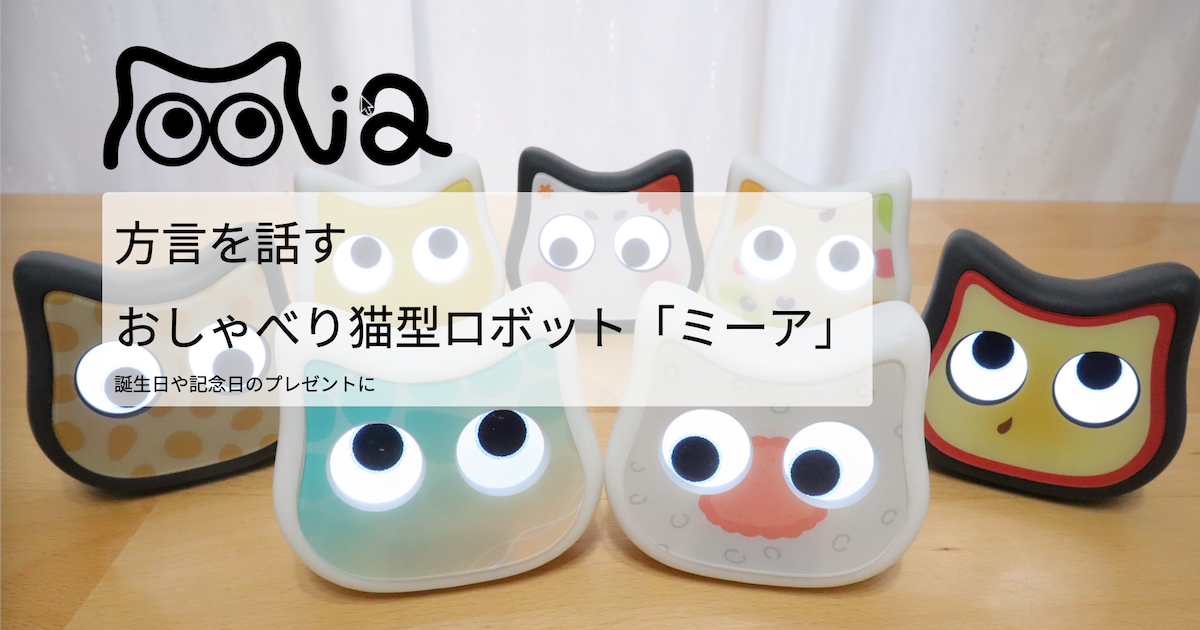
Mia (ミーア): A Voice-First AI Cat Robot With Dialects and Family Messages

Mia (ミーア) is a cat-shaped AI pet robot built around voice, facial expressions, touch reactions, weather and calendar prompts, Japanese dialects, and recorded family messages.
It does not move around the home like LOVOT or aibo. It is not a soft holdable robot like Moflin.
Instead, Mia creates attachment through voice: hearing a familiar phrase, enjoying regional dialects, and receiving a message from family. It is easier to understand as an approachable daily voice companion than as a high-end mobile robot.
ElliQ: A Voice Companion for Independent Aging
ElliQ is a companion robot designed for older adults, especially people aged 60 and older who live alone or spend much of the day alone. Its official site describes wellness support, medication reminders, communication with loved ones, entertainment, and proactive conversation.
ElliQ is interesting because it does not try to look like a dog or cat. It creates companionship through voice, routine, encouragement, and daily check-ins.
Including ElliQ in the comparison helps separate two ideas: a robot can feel companion-like through pet-style physicality, or it can feel companion-like through repeated voice interaction and daily support.


Moxie: A Conversation Robot for Children's Social-Emotional Learning
Moxie is designed around children's social-emotional development. Its FAQ describes reading, affirmations, interactive stories, meditation, open conversations, emotional regulation, and parent app customization.
Moxie is not mainly a pet robot. It is closer to an educational companion. Still, it belongs in this comparison because it uses a face, voice, conversation, memory, and repeated interaction to build a relationship with the child.
For children's AI robots, conversation quality is only one part of the decision. Parent controls, age fit, content design, privacy, safety, and long-term engagement matter just as much.

Touch: Attachment Through Holding, Stroking, and Softness

Touch-based AI pets can create attachment even when they do not speak.
Holding, stroking, feeling softness, and noticing a small reaction can make a robot feel present. In human-robot interaction research, social and affective touch is an important design topic because touch can communicate trust, comfort, and care without words.
This helps explain why quiet robots such as Moflin and Qoobo can still feel emotionally engaging.
Moflin: A Quiet AI Pet That Leaves Room for Projection
Moflin is Casio's fluffy AI pet. Its appeal comes from touch, sounds, movement, and the way its personality can change through interaction.
Moflin does not try to win users through long human-like conversation. That is part of the point. Because it does not explain too much, users can read meaning into its sounds and reactions.
In a world where more robots are adding generative AI conversation, Moflin is a useful example of attachment through quietness and softness.
Qoobo: A Tail Is Enough to Suggest Presence
Qoobo is a cushion-style robot with a tail. It has no face, no words, and no complex conversational AI.
But when the tail moves in response to touch, people can still feel a hint of emotion or presence. That simple design makes Qoobo a strong example of nonverbal attachment.
Qoobo shows that AI pet robots do not always need eyes, speech, or animal realism. Sometimes a small physical response is enough.
PARO: A Therapeutic Robot Built Around Calm Physical Comfort
PARO is a seal-shaped therapeutic robot. It is older than many current AI pet robots, but it remains important when discussing robot attachment in healthcare and elder-care settings.
PARO does not rely on generative conversation. It uses softness, sounds, being held, and simple reactions to create comfort.
When comparing robots for dementia care, elder care, or quiet emotional support, PARO is useful to compare with Mia (ミーア), ElliQ, LOVOT, and Tombot Jennie.

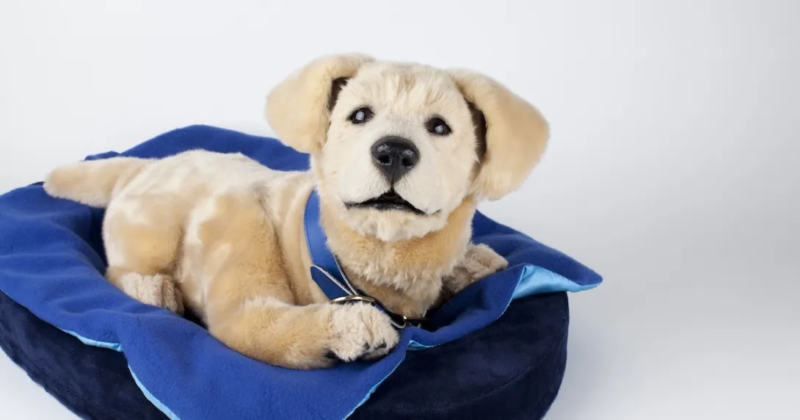
Tombot Jennie: A Realistic Robot Dog for Emotional Support
Tombot Jennie is a realistic robot dog. Tombot presents it as a robotic emotional support animal for people who may not be able to care for a live pet, including people affected by dementia or other challenges.
Jennie creates attachment through a dog-like body, realistic appearance, tactile comfort, and animal-like responses rather than open-ended conversation.
For English readers, Jennie is a useful comparison point next to PARO and aibo: it is more care-oriented than aibo, and more dog-like than PARO.
Movement: Attachment Through a Body That Acts on Its Own

When a robot moves on its own, users often read intention into it.
Approaching, turning, following, going back to charge, or moving through a room can make the robot feel more alive. Movement creates a different kind of presence than voice.
LOVOT: A Home Robot Designed to Be Loved
LOVOT is a home robot known for prioritizing emotional presence over practical tasks. Warmth, eye expression, mobility, and being held are central to the experience.
LOVOT's attachment design is less about long conversation and more about looking, approaching, being held, and being cared for.
It is expensive compared with many smaller AI pets, but it offers one of the strongest "living with a robot" experiences in the consumer market.
aibo: A Robot Dog Built Around Movement, Growth, and Memory
aibo is Sony's robot dog. Its appeal comes from dog-like movement, play, recognition, cloud-supported AI, growth, and changing personality.
aibo works because it connects to what people already expect from a dog: walking, reacting, learning, and playing. That makes it easier for users to treat it as a pet-like robot rather than a generic gadget.
It is not a live dog, of course. Buyers should still check price, support, cloud services, repair options, and long-term service conditions.

Loona: A Modern Moving AI Companion With Conversation
Loona combines movement, expressions, learning, AI conversation, and ChatGPT-style interaction. Its official page emphasizes emotional expression, learning growth, AI dialogue, voice reactions, movement, and touch responses.
Loona sits between pet-like physical behavior and modern conversational AI.
For readers, it is a clear example of the current direction of AI companion robots: not only moving, not only talking, but trying to combine both.

Eilik and EMO: Small Desktop Robots That Create Presence at a Desk
Eilik and EMO do not roam around the whole home like LOVOT or aibo. They create presence on a desk through expressions, touch reactions, movement, and small social cues.
This category matters because attachment does not always require a large robot. A small face, a simple reaction, or a moment of eye contact during work can be enough to make a robot feel present.
For office desks, study spaces, and small rooms, desktop companion robots may be easier to live with than larger mobile robots.
Growth and Memory: Attachment Through a Relationship That Accumulates
Another reason people attach to AI pets is the feeling that the relationship is building over time.
The robot learns a name, remembers preferences, changes its reactions, or develops a personality. When that happens, users may feel that the robot is not just "a product" but "my robot."
aibo, Moflin, LOVOT, Loona, and Moxie are useful examples of this pattern.
Growth and memory also raise practical questions. Where is the data stored? Is cloud access required? Is there a subscription? What happens if the service ends? If you plan to live with an AI pet for years, these questions matter.

Silence and Imperfection: Attachment Without Too Much Explanation
It is tempting to judge AI pets by how well they can talk.
But conversation is not always the strongest path to attachment. In some cases, talking too much can make a robot feel less pet-like.
Moflin, Qoobo, and PARO do not answer every question. Their reactions are simple. That simplicity leaves space for the user to interpret, imagine, and project emotion.
This is an important point when choosing an AI pet.
If you enjoy conversational AI, Loona, Romi, ElliQ, Moxie, and Mia (ミーア) may be better fits. If you want something quiet and calming, Moflin, Qoobo, PARO, or Jennie may feel more natural.
Which Attachment Type Should You Choose?
If You Want a Daily Conversation Partner
Compare Mia (ミーア), Romi, ElliQ, Moxie, and Loona.
Mia is easier to understand if you want Japanese voice prompts, dialects, family messages, weather, and calendar-related speech. ElliQ is important for English-speaking older adults. Moxie is more relevant for children's social-emotional learning. Loona is useful if you want both movement and conversation.

If You Want Something to Hold or Stroke
Compare Moflin, Qoobo, PARO, LOVOT, Tombot Jennie, Cupboo, and similar fluffy or tactile robots.
Do not judge this category only by conversation. Look at softness, size, weight, sound level, whether it can be held, and whether the reactions feel calming or distracting.

If You Want Something Close to a Real Pet
For dog-like robots, compare aibo, Tombot Jennie, and Dog-E. For cat-like robots, compare MarsCat and other cat-style AI robots. For more abstract pets, compare Moflin, Qoobo, and LOVOT.
More animal-like does not always mean better. If a robot looks very realistic, users may expect more realistic behavior. A more abstract robot can sometimes be easier to accept because it does not promise to replace a real animal.

If You Are Choosing for an Older Adult
For older adults, conversation ability is only one factor. Ease of operation, volume, weight, charging, privacy, family communication, and low risk of confusion are just as important.
PARO and Tombot Jennie are useful tactile and care-oriented examples. ElliQ is a major voice companion example in English-speaking markets. Mia (ミーア), BOCCO emo, and similar robots may be easier to compare when Japanese voice prompts or family messages matter.
If You Are Choosing for a Child
For children, open conversation is not enough. Safety, parent controls, age fit, content quality, privacy, and whether the child will keep using the robot all matter.
Moxie is a strong international example for social-emotional learning. Miko, Curio, Loona, and digital pets sit closer to play, learning, and entertainment.

What Research Adds: Attachment Is Not Just Usefulness
Human-robot attachment is studied through areas such as human-robot companionship, social robots, social presence, human-robot attachment, and robot touch.
A 2024 review on human-robot companionship summarizes how robots have been used as companions across healthcare, education, entertainment, rehabilitation, and well-being.
Research on attachment to robots also points to both benefits and risks. Attachment may support acceptance, natural interaction, companionship, and well-being, but it can also raise concerns about one-way emotional bonds, overreliance, privacy, and influence.
Touch is another important area. Research on robot touch discusses how touch can become a social or emotional interaction, not just a mechanical control. PARO studies in dementia and chronic pain care also show why therapeutic robots are often discussed separately from ordinary consumer gadgets.
The practical lesson for product comparison is simple: instead of saying "this robot is healing," it is better to explain which interaction creates attachment and what trade-offs come with it.
References:


Summary: Choose by Relationship Design, Not Just Specs
When choosing an AI pet robot, start with the kind of relationship you want.
- Choose voice and conversation if you want a daily talking companion.
- Choose touch if you want something to hold or stroke.
- Choose movement if you want stronger life-like presence.
- Choose growth and memory if you want a relationship that changes over time.
- Choose silence and ambiguity if you want quiet comfort.
- Choose family connection if messages and shared routines matter.
LOVOT, Moflin, aibo, PARO, Loona, ElliQ, Moxie, Tombot Jennie, Qoobo, and Mia (ミーア) all create the feeling of "not just a tool" in different ways.
That is why AI pet robot comparison should go beyond price and features. Voice, touch, movement, growth, care, silence, and family connection are often what decide whether a robot actually fits your life.

👀 You may also like:
👉 2026 Guide: AI Pet Robots for Elderly Loneliness – A Comparison of 10 Companion Robots
👉 2026 Edition: 9 Recommended Pet Robots Under $150 – Cheap, Cute, and Healing Models
👉 Monthly and Maintenance Costs of Pet Robots: Moflin, LOVOT, Mia, and More
👉 Mia – Your Chatty AI Cat Companion Robot with 100+ Expressions