- What Is Amoo?
- Quick Summary
- Short Verdict
- What Can Amoo Do?
- Cyan Robotics' Character Robot Strategy
- Dino OS and Dino WM: What Is Inside Amoo?
- Exhibition and Media Response
- Price, Release Timing, and Japan Availability
- Business Model: Hardware, Content, and IP
- How Amoo Differs From Similar Robots
- Who Might Like Amoo?
- What To Check Before Buying
- Summary
What Is Amoo?
Amoo, also written as 阿莫, is a small biped AI robot developed by Cyan Robotics, also known as 青心意創, in Shanghai.
On its official site, Amoo is described as an approximately 80 cm "Embodied Character" robot. Its defining feature is a soft, blanket-like outer shell that hides sharp edges and exposed mechanical parts as much as possible.


Image source: Cyan Robotics official site
Many humanoid robots focus on work: factories, logistics, security, research, or industrial automation. Amoo is aiming at a different space. Its pitch is not productivity first, but emotional presence inside the home.
Visually, Amoo feels closer to a walking plush character than a traditional robot. Cyan Robotics presents it less as a tool waiting for commands and more as a character that can approach people on its own.
Quick Summary
What Amoo Is
- A small AI robot from Shanghai-based Cyan Robotics
- Presented as an ultra-small humanoid around 80 cm tall
- Designed with a fluffy outer shell, fewer hard edges, and reduced visible metal parts
- Promises autonomous bipedal walking, obstacle avoidance, and user search across rooms
- Combines panoramic vision, sound-source localization, and full-body tactile sensing
- Positioned as a robot for emotional connection at home, not as a housework robot
- Price, release timing, and Japan availability have not been officially announced on the official site
What Looks Promising
- Easy to understand as an extension of emotional companion robots such as LOVOT and Romi
- Biped movement may give it a stronger sense of presence than a stationary AI speaker
- The soft character design helps reduce the cold mechanical feeling of humanoid robots
- It aims to combine gaze, body movement, walking style, voice, and distance into emotional expression
- The concept could fit homes, children, older adults, commercial venues, and character IP collaborations
- It makes China's physical AI race easier for everyday consumers to understand
What To Watch Out For
- Price, release date, Japan sales, and production volume are still unclear
- Important home-use details such as battery life, operating noise, fall safety, and step handling are limited
- Exhibition demos alone are not enough to judge real autonomy
- Cameras, microphones, and tactile sensors make privacy and household data handling important
- If used around children or older adults, dependency, paid content, and content safety also matter
- For now, most information comes from announcements, exhibitions, and media coverage rather than long-term owner reviews
Short Verdict
Amoo is less a product to compare for immediate purchase and more a robot to watch as a sign of where home robotics may be heading.
It is not a humanoid for doing chores, carrying boxes, or working in factories. Amoo is aiming for a character-like home robot that stays near the user, responds, approaches, and expresses emotion through gestures.
For Japanese readers, it may be easiest to understand Amoo as something between healing companion robots such as LOVOT, Romi, and Moflin, and the new wave of biped humanoid robots.
However, buying information is still limited. To judge it as a finished home product, we would need real hands-on reviews, long-term use reports, app details, cloud service details, warranty terms, and language support information.
For now, the safest reading is this: Amoo is an exciting glimpse of a cute future home robot, but its practical value and sales conditions still need careful confirmation.
What Can Amoo Do?
Walk as a Soft Small Humanoid
Amoo's clearest feature is the combination of a compact body, around 80 cm tall, and bipedal walking.
The official site says Amoo supports autonomous bipedal walking, obstacle avoidance, and finding users across rooms. The goal appears to be a robot that can move near people on its own and interact at a safe distance.
When people hear "biped robot," they often imagine a hard metallic machine. Amoo takes the opposite direction by covering the whole body with a soft exterior and reducing the sense of pressure it might create in a living space.
News from Shanghai's Xuhui District describes Amoo as being in the 60 to 80 cm height range. Founder Niu Tenghao explains that companion robots can feel oppressive if they are too tall, while making them too small creates challenges for sensing and walking control.

In other words, Amoo is not just trying to be small and cute. It is searching for a size that feels approachable at home while still being large enough to move and sense like a robot.
Express Emotion Through Face, Voice, and Body
Amoo emphasizes full-body emotional expression, not only conversation.
The Xuhui report describes Amoo reacting to questions with gestures such as placing its hands on its waist, changing its eye expressions, and responding with its own "space language"-like sounds.
That direction is different from ordinary AI speakers or chatbots. Instead of replying from a screen or speaker, Amoo aims to respond near people by combining gaze, posture, walking, distance, and sound.
Cyan Robotics also describes Amoo with phrases such as "Real-time Interaction," "Non-NPC," and "Understanding You." The message is that Amoo is meant to behave less like a game NPC with fixed responses and more like a character shaped by an ongoing relationship.
Recognize People and Spaces Through Vision, Sound, and Touch
According to the official site, Amoo combines panoramic vision, sound-source localization, and full-body tactile sensors.
TEAMS Design's case study also describes Amoo as perceiving expression, movement, voice, and body contact through visual, audio, and tactile sensors, with Cyan's OS processing that information into behavior.

This matters for home robotics because it suggests Amoo may not always need the user to say, "Amoo, come here." The robot is being designed with room to read the situation and approach by itself.
Of course, we need real product reviews before saying how natural that behavior is in a home. But the direction is clear: Amoo is not just a voice-command robot. It is trying to build relationships through facial expression, voice, movement, touch, and distance.
Cyan Robotics' Character Robot Strategy
Designed as "Someone," Not a Tool
TEAMS Design describes Amoo's concept as "Someone, not something."
The idea is to design Amoo not as a convenient tool, but as a presence that people naturally want to approach.
According to TEAMS Design, Amoo applies the technology base of Cyan Robotics' full-size humanoid ORCA to the emotional companion robot space. It is imagined as a home companion for children, older adults, people living alone, and families.
The same page also says Amoo was developed to first reveal in about ten months and mentions that Cyan raised funding on the scale of 100 million yuan for its next-generation companion robot platform.
Amoo and ORCA Share One Embodied Intelligence Core
Cyan Robotics presents Amoo and ORCA under the phrase "Two Characters, One Embodied Intelligence Core."
ORCA is introduced as a full-size humanoid: 1.45 m tall, 40.5 kg, and 28 degrees of freedom, with straight-knee walking, dual-arm manipulation models, and emotional gait models.
Amoo, by contrast, is an ultra-small home-oriented robot. The size and use case are very different, but Cyan treats both as different characters created from a shared robotics foundation.
That is an interesting way to frame the product. Instead of making one robot for one narrow use case, Cyan seems to be combining an OS, motion models, and character design into a platform for multiple robot IPs.
Dino OS and Dino WM: What Is Inside Amoo?
Dino OS as a Reusable Character Platform
Cyan Robotics introduces Dino OS as the technology platform behind Amoo.
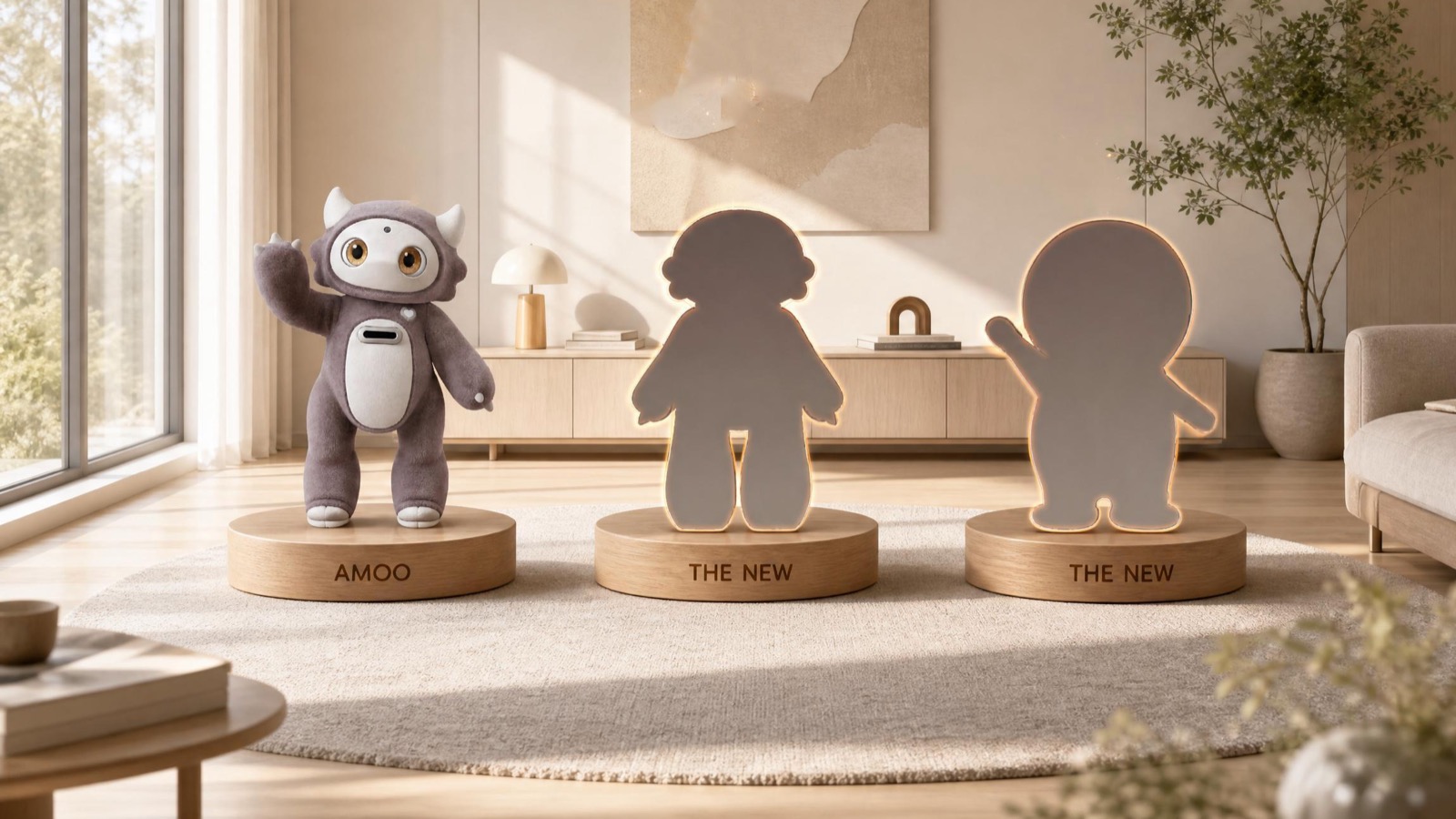
Image source: Cyan Robotics official site
The official site describes Dino OS as a foundation that can be reused across multiple IPs and characters. Instead of building each character from scratch, Cyan aims to standardize behavior units and interfaces, then adapt them for different scenarios and roles.
The company says Dino OS can shorten development cycles from years to months.
For home robots, that idea matters because a single robot may not need to stay locked into one personality or one function. The same platform could potentially expand into education, monitoring, fitness, commercial guidance, and character IP experiences.
From "Listen and Execute" to "Understand and Respond"
The official site describes Dino OS's model layer with ideas similar to "cerebrum and cerebellum" or "fast brain and slow brain."
In plain terms, that means separating quick-response processing from deeper situational understanding, then reflecting both in movement and conversation.
Traditional home robots often follow a simple flow: the user calls, gives an instruction, and the robot answers. Amoo appears to be reaching for something more advanced: understanding how the user is doing, what distance is appropriate, and what gesture should come before words.
Dino WM, the Social World Model Shown at GeekPark
According to GeekPark, Cyan Robotics introduced its social world model "Dino WM" at the Bund Conference in September 2026.

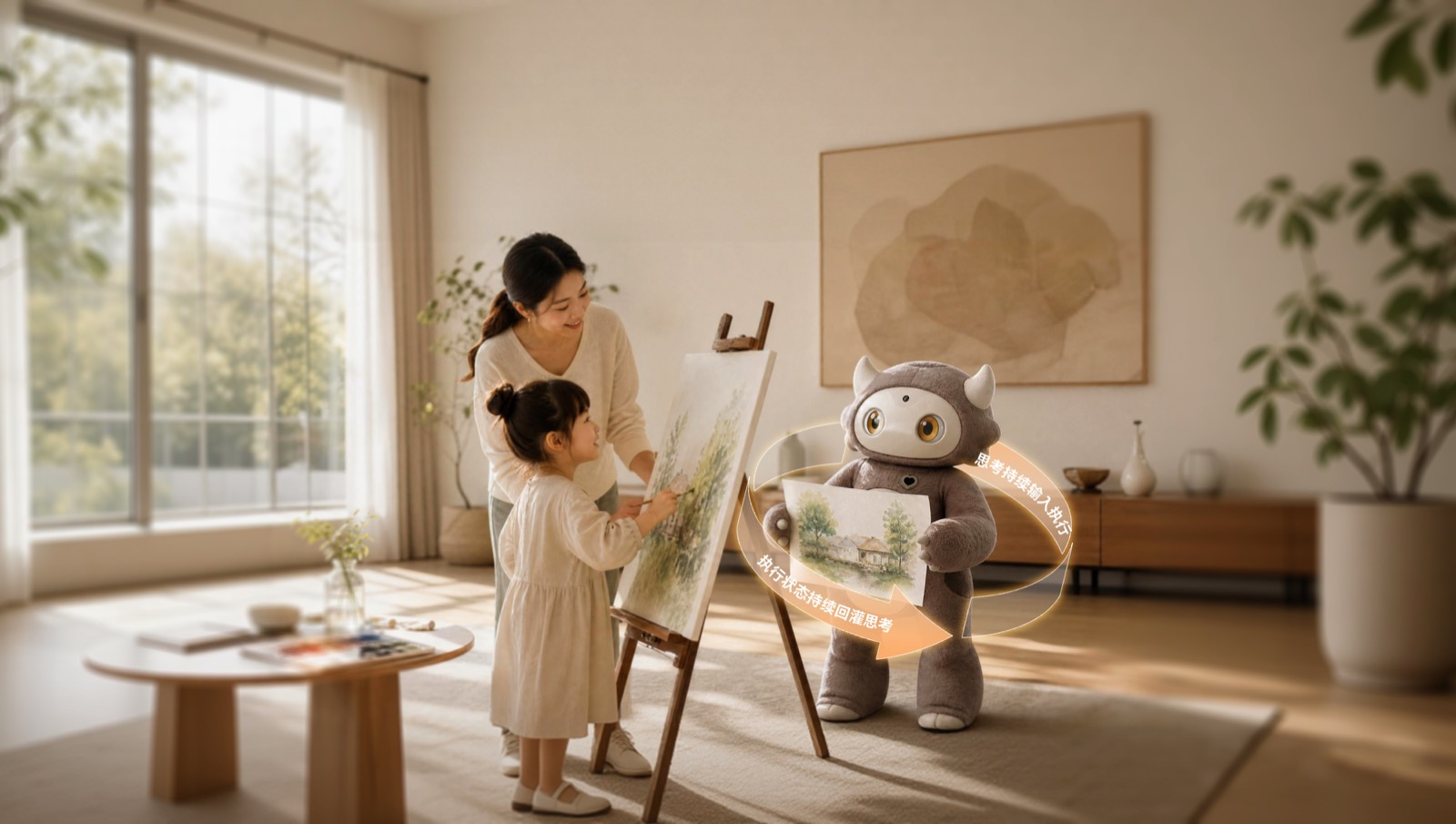
Image source: Cyan Robotics official site
The article describes Dino WM not as a simple system that recognizes "the user is smiling" and picks a response, but as a model that handles actions, states, emotions, and relationships together, then predicts what may happen next.
For example, if a child is playing with building blocks, the system would not only identify that the child is smiling. The idea is to understand whether the blocks may fall, what the child wants to build, and how to respond if the structure collapses.
That is an idealized description, and we should be cautious about how much is already working in real homes. Still, it shows that Amoo is aiming beyond voice conversation toward an AI robot that includes the body and the relationship itself.
Exhibition and Media Response
First Shown at AWE 2026
Amoo was reportedly first shown at AWE 2026 in March 2026.
The Xuhui District report says Amoo appeared at the AWE 2026 venue in Shanghai's Eastern Hub International Business Cooperation Zone and interacted with visitors.
Aibang Robotics also reported that Amoo moved, reacted with gaze and voice, and showed bodily expression in front of the audience. The article described the exhibition as an important milestone before formal market launch, with visitor reactions and improvement requests feeding future development.

That suggests Amoo should be seen less as a fully released retail product and more as a robot still being refined through exhibition feedback and market response.
Also Noticed at IFA 2026
Spain's Cinco Dias included Amoo among notable gadgets seen at IFA 2026.

The article treated Amoo as a robot moving away from cold mechanical appearance and toward more organic interaction through vision, hearing, and touch.
In other words, Amoo is not only attracting attention in China. It is also being noticed in Europe as an unusual AI robot that might enter the home.
MGM Shanghai West Bund Collaboration
Cyan Robotics' official site also shows a collaboration between Amoo and MGM Shanghai West Bund.
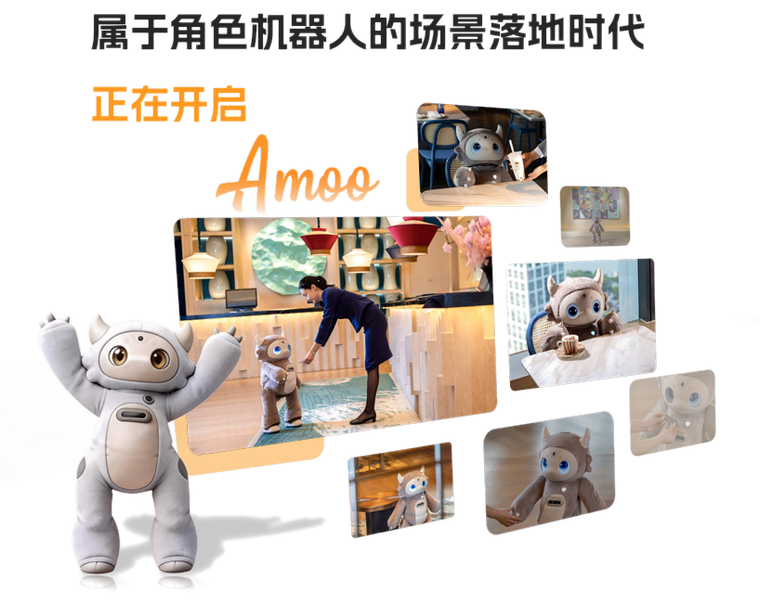
Image source: Cyan Robotics official site
According to the official site, this project positions Amoo not only as a product demo, but as a robot that may be used in hotels, tourism, brand collaborations, and other commercial spaces. That character-IP and hospitality direction is another important part of Amoo's identity.
Price, Release Timing, and Japan Availability
Amoo's Price Has Not Been Announced
Amoo's consumer price has not been published on the official site.
The official site includes contact paths for product purchase, media cooperation, ecosystem cooperation, and supply-chain cooperation, but I could not confirm a public consumer price list or purchase button.
Here is the current situation:
| Item | Current status |
|---|---|
| Main unit price | Not announced |
| Pre-order price | Not confirmed |
| Monthly fee | Not announced |
| Japan price | Not announced |
| Public retail page | Not confirmed on the official site |
| Business or collaboration inquiry | Contact routes exist on the official site |
For that reason, Amoo cannot yet be judged as a robot with a clear purchase price. At the moment, it is better understood as a notable home companion robot under development and exhibition.
There is one important price-related point. Amoo is not just a fluffy toy. It combines biped walking, vision, sound-source localization, full-body tactile sensing, and an AI character platform. If it becomes a consumer product, it may cost more than a simple AI plush toy or tabletop conversation robot.
Securities Times also reported that a person connected with Cyan Robotics described a combined model close to hardware revenue, content subscription, and IP licensing. In other words, the eventual cost might include not only the robot body, but also character content, conversation features, cloud AI, or IP collaborations.
When evaluating Amoo, the purchase price alone will not be enough. Shipping, import duties, warranty, repair, battery replacement, exterior replacement, app fees, and cloud subscriptions may all affect the real cost.
Release Timing and Production Status Need Caution
Amoo has appeared at AWE 2026, IFA 2026, and other public events, but I could not confirm an official announcement for mass production, general retail sales, or Japan sales.
For now, the safest understanding is:
- Cyan Robotics is developing and exhibiting a small AI robot
- It is being proposed as a home companion robot
- Public price and Japan availability are unconfirmed
- Most information is still from exhibitions, announcements, and media reports
It would be too early to say that Amoo has launched, can be bought from Japan, or is ready for ordinary home use.
What To Check Before Using Amoo in Japan
If you are interested in Amoo from Japan, there are many things to confirm.
| Check item | What to look for |
|---|---|
| Sales status | General sales, pre-order, business demo, or IP partnership |
| Price | Main unit, shipping, customs, consumption tax, repairs, subscriptions |
| Japan shipping | Shipping availability, warranty, return conditions |
| Radio compliance | Japan rules for Wi-Fi, Bluetooth, and other wireless features |
| App | Japanese UI, Japanese voice, Japanese support |
| Conversation AI | Japanese conversation, Japanese character settings, child-safety settings |
| Privacy | Storage and deletion of camera, microphone, touch, and household data |
| Safety | Falls, joints, heat, contact with children or pets |
| Maintenance | Dirt on the exterior, cleaning, battery replacement, repair routes |
The fluffy shell is friendly, but if the robot is touched every day at home, dirt, durability, and cleaning methods become very practical concerns.
Business Model: Hardware, Content, and IP
Securities Times reported that Cyan Robotics is considering a mixed model close to hardware revenue, content subscriptions, and IP licensing.
https://epaper.stcn.com/att/202604/14/6cac6ca9-98d8-452d-9618-49c78249022d.pdfThat is a natural direction for AI robots and AI toys. Continuous conversation, character updates, educational content, cloud AI, voice synthesis, and app updates all create ongoing operating costs.
For users, though, it also creates questions:
- Which features are free after buying the robot?
- Will conversation or learning features require a monthly fee?
- Will children's content involve extra payments?
- Could IP character versions become more expensive?
- What stops working if the subscription is cancelled?
The Securities Times article also discusses wider concerns around AI toys, including recurring payments, children's dependency, privacy, and age-appropriate safety design.
Amoo is easy to introduce as a cute robot, but because it is an AI robot entering the home, the real evaluation has to include cost, data, safety, and children's use.
How Amoo Differs From Similar Robots
Amoo vs LOVOT
LOVOT is one of Japan's best-known emotional home robots. It is designed to remember faces, approach people, be held, and build affection inside the household.
Amoo shares LOVOT's focus on emotional relationship, but it appears to place more emphasis on biped humanoid embodiment and character IP expansion.
| Comparison | Amoo | LOVOT |
|---|---|---|
| Form | Small biped humanoid | Wheeled emotional companion robot |
| Exterior | Fluffy character shell | Soft clothes and rounded body |
| Main value | Character expression, walking, relationship | Being held, eye contact, approach behavior, household attachment |
| Sales status | Price and general sales not confirmed | Sold and supported in Japan |
| Caution | Practical information is still limited | Main unit and monthly fees are required |
Amoo may be understood as adding humanoid technology and character IP elements to the emotional home robot path that LOVOT helped define.
Amoo vs Romi
Romi is a home communication robot centered on conversation.
Amoo is not only about conversation. It emphasizes walking, approaching, and expressing through the body. If Romi is a tabletop conversation partner, Amoo is closer to a character that moves through the room.
| Comparison | Amoo | Romi |
|---|---|---|
| Form | Small humanoid around 80 cm | Tabletop communication robot |
| Movement | Promises biped walking | Generally does not move around |
| Strength | Body expression, distance, character presence | Conversation, daily prompts, Japanese language support |
| Ease of buying in Japan | Unconfirmed | Easy to buy in Japan |
For Japanese homes, Romi is easier to adopt right now. Amoo is more useful as a glimpse of how home robots may change once physical embodiment becomes stronger.
Amoo vs Mia
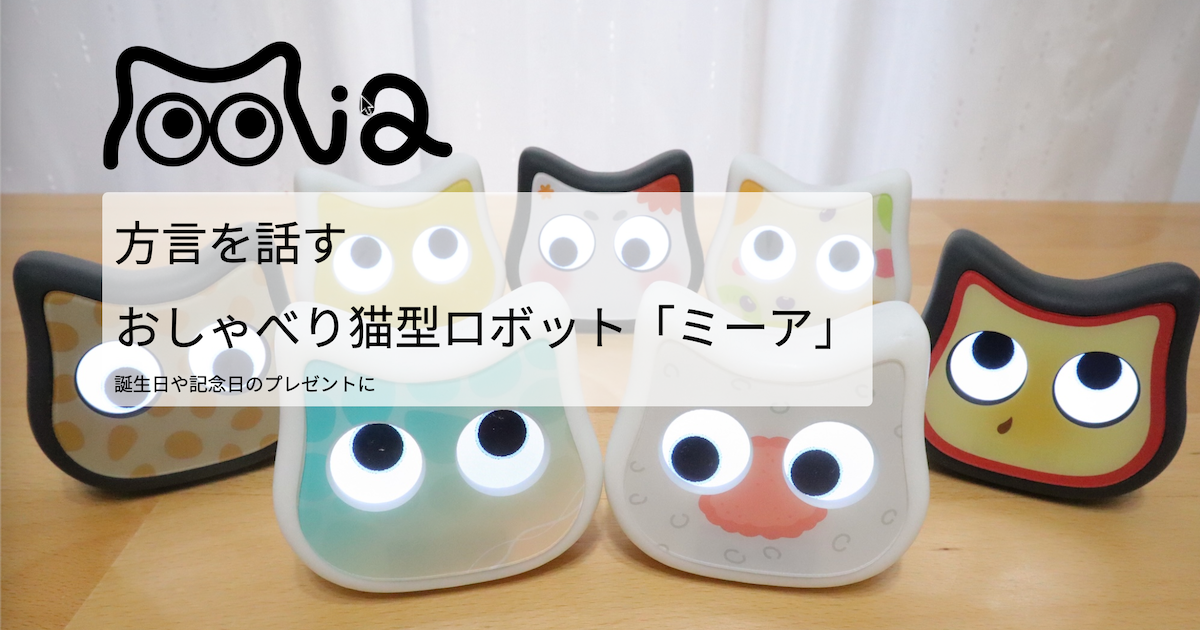
Mia is an AI pet robot shaped around the idea of a cat-like companion, using conversation, expressions, voice, and gestures to create presence at home.
Amoo is not cat-shaped. It is a small humanoid character robot. If Mia is a cat-like companion, Amoo is closer to a walking character companion.
| Comparison | Amoo | Mia |
|---|---|---|
| Motif | Original character-style robot | Cat-style AI pet |
| Main appeal | Biped walking, fluffy shell, full-body expression | Cat-like charm, conversation, expressions, daily voice prompts |
| Use case | Mostly exhibition and development information for now | Home conversation and comfort |
| How to frame it | China's physical AI and next-generation home robot direction | An AI pet suited to everyday Japanese homes |
If you want the feeling of a cat-like pet, Mia is the more natural category. If you want to watch the future of walking character robots, Amoo is the more interesting case.
Who Might Like Amoo?
If Amoo becomes available as a product from Japan, it may suit people who:
- Are strongly interested in new home robots and physical AI
- Like emotional companion robots such as LOVOT and Romi
- Are attracted to both plush-like texture and robot movement
- Are interested in communication robots for children or older adults
- Like the combination of character IP and robotics
- Care more about the future direction of home robotics than immediate practical utility
On the other hand, Amoo should be approached carefully by people who:
- Want a robot they can buy in Japan right now
- Put practical functions such as housework, monitoring, or care assistance first
- Want to avoid monthly fees or cloud-connected features
- Are uncomfortable with cameras and microphones inside the home
- Need strict control over children's AI-device dependency or in-app purchases
What To Check Before Buying
1. Price and Monthly Fees
Amoo's price is not confirmed. If it is sold in the future, the real cost may include not only the main unit, but also AI conversation, character updates, content, and cloud storage fees.
AI robots can become much more or less satisfying depending on what happens after purchase. Before buying, check what is free, what is paid, and what becomes unavailable if a subscription is stopped.
2. Japanese Language Support
For use in Japan, Japanese conversation, a Japanese app, and Japanese support will be close to essential.
Amoo is a China-origin robot, so early demos may focus on Chinese or English. Natural Japanese conversation, child-safe Japanese responses, and support for Japanese household habits all need separate confirmation.
3. Home Safety
Amoo is a biped robot. Even with a cute design, it is still a moving machine.
Important points include fall behavior, foot safety, pinch risks around joints, heat, charging safety, and how it reacts when children or pets touch it.
The official site emphasizes fewer sharp edges and anti-pinch design, but for long home use, independent reviews and safety certification information would also be valuable.
4. Privacy and Data Storage
Amoo uses vision, sound, and touch. In the home, that makes it important to understand where camera images, audio, conversation history, touch data, and behavior logs are stored.
Especially when used around children or older adults, check:
- Whether video or audio is sent to the cloud
- How long data is stored
- Whether users can delete it
- Whether data is shared with third parties or used for training
- Whether there are child-focused privacy protections
Home robots should be evaluated not only as cute companions, but also as data devices.
5. Long-Term Support
AI robots lose much of their appeal if software updates stop.
Before buying, check warranty period, replacement parts, battery replacement, exterior replacement, app updates, and cloud service continuity.
For overseas products, it is especially important to know whether repairs can be handled from Japan, what shipping would cost, and whether support is available in a language you can use comfortably.
Summary
Amoo is a small soft-covered biped AI robot developed by Cyan Robotics.
The official site describes it as an ultra-small humanoid around 80 cm tall, with autonomous walking, obstacle avoidance, user search, panoramic vision, sound-source localization, and full-body tactile sensors.
What makes Amoo interesting is that it is not trying to be a convenient appliance. It is aiming to become a character that enters the home. A robot that receives facial expression, voice, touch, and distance, then responds with its whole body, could create an experience very different from an AI speaker or chatbot.
However, price, release timing, Japan availability, and long-term user reviews are still limited. There are many points to confirm before treating it as a ready-to-buy home robot.
Amoo is best understood as a notable example of where home robots may go next. It asks a simple but important question: what happens when the emotional robot path of LOVOT and Romi meets biped humanoid technology and character IP? Amoo is one of the clearest answers to that question coming out of China right now.
👀 You may also like:
👉 2026 Guide: AI Pet Robots for Elderly Loneliness – A Comparison of 10 Companion Robots
👉 2026 Edition: 9 Recommended Pet Robots Under $150 – Cheap, Cute, and Healing Models
👉 Monthly and Maintenance Costs of Pet Robots: Moflin, LOVOT, Mia, and More
👉 Mia – Your Chatty AI Cat Companion Robot with 100+ Expressions