What Is MIO AI?
MIO AI is a palm-sized AI partner from Jinwa Shoji Co., Ltd. (Bunkyo, Tokyo), currently running as a crowdfunding campaign on Makuake, Japan's leading "support purchase" platform.
The campaign tagline is "It remembers. It grows. Your own AI partner" — positioning MIO AI as more than a question-answering AI speaker. The core idea is that conversations accumulate over time, and the relationship between the user and the AI deepens the longer it is used.
The body is a rounded, reinforced-glass housing paired with a high-sensitivity microphone and a quality speaker. The official page doesn't list exact dimensions, but it describes MIO AI as "palm-sized," and the transparent glass design gives it a crystal-ball or orb-like presence that can sit naturally on a desk or nightstand.
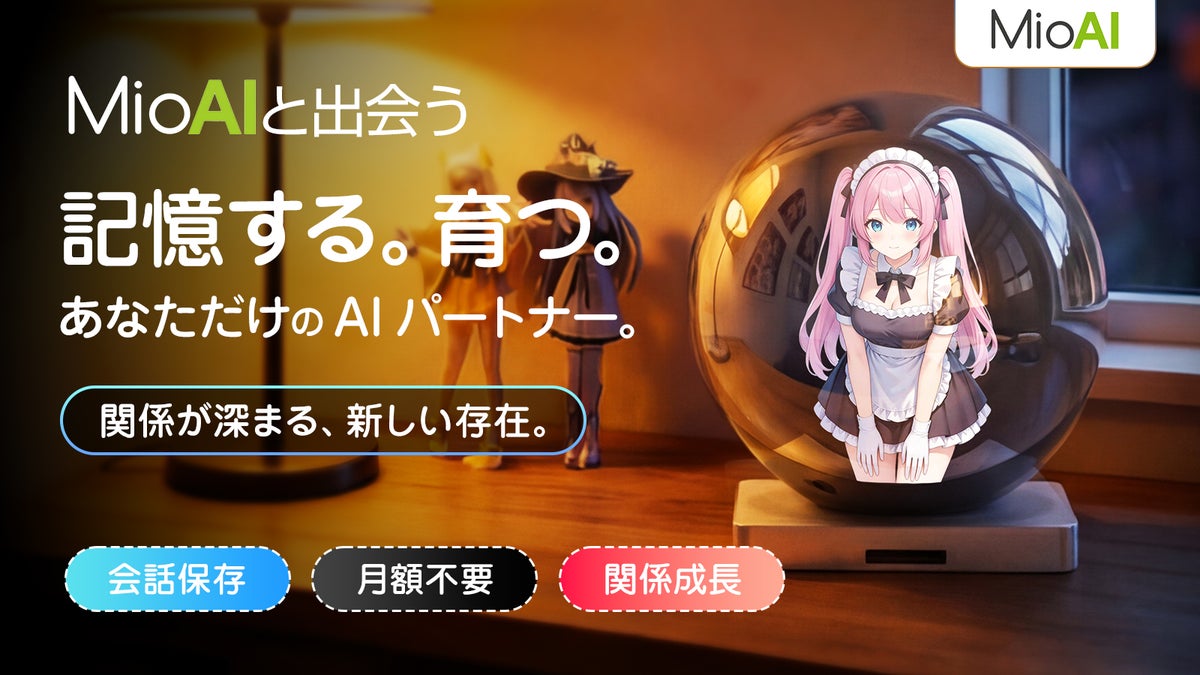
The official visuals show an original AI character appearing to float inside the glass orb. The physical device itself does not have a display that shows a character — it's a voice-based glass speaker — but MIO AI's marketing leans heavily on this character illustration to convey the feeling of "an AI partner that's really there."
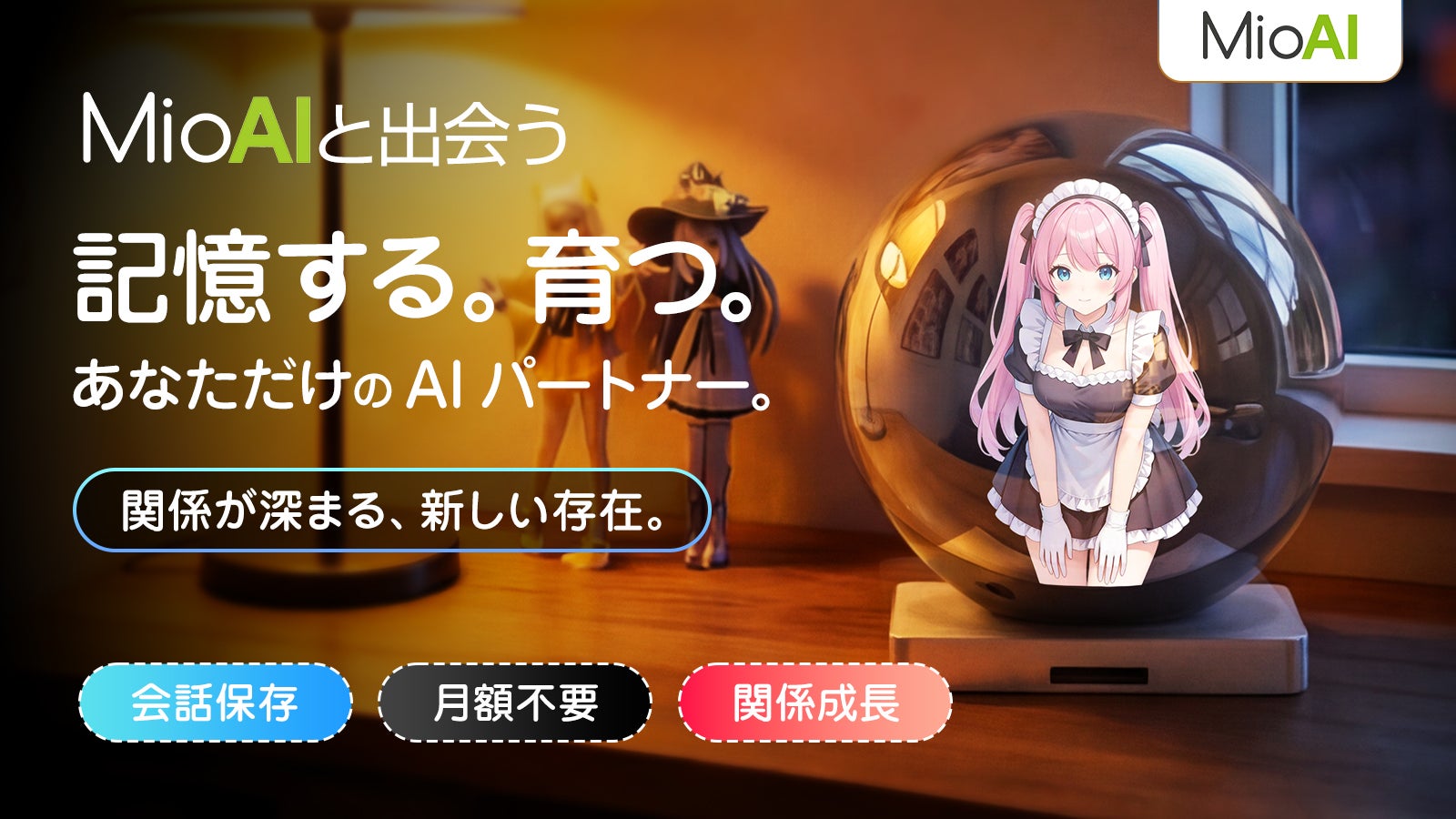
The Makuake campaign runs from August 21 to October 30, 2026, with delivery expected by the end of November 2026. Against a funding goal of 199,999 yen, several early-bird tiers were already marked "sold out due to popularity" at the time of writing.
Key Takeaways
What MIO AI Is
- A palm-sized AI partner from Jinwa Shoji Co., Ltd.
- Currently a Makuake crowdfunding campaign, with delivery expected by the end of November 2026
- A rounded, reinforced-glass body with a crystal-ball or orb-like look
- Built around long-term memory, so the relationship is meant to deepen with continued use
- Expression and conversation tone shift based on mood and topic
- Supports voice control, alarms, memos, language-learning assistance, and song requests
- Uses Wi-Fi to accumulate conversation history
What Looks Good
- The "an AI that matters more the more you use it" concept is clear and distinct from a simple relationship-building focus over pure convenience
- The glass design offers a different kind of presence than typical cat- or dog-shaped pet robots
- Early-bird pricing starting at 35,800 yen is more accessible than face-to-face AI companion devices like Gatebox3 or CODE27
- Practical extras like language-learning support and song requests go beyond conversation alone
What Needs Caution
- As a Makuake crowdfunding project, manufacturing and shipping timelines can shift after backing
- Details such as exact dimensions, color options, and whether there's any visual display are not disclosed as of this writing
- There's limited detail on Japanese conversation accuracy, offline behavior, and where/how long-term memory data is stored
- Many early-bird tiers are already sold out, so backers may end up paying the standard price
Who Might Like It
- People who want a presence to talk to during solo time
- Those who want a stronger sense of "a growing relationship" than a typical smart speaker offers
- Anyone interested in AI character devices like Gatebox3 or CODE27 but held back by price or footprint
- Early adopters comfortable with crowdfunding risk who want to try a new kind of AI gadget early
Quick Take
MIO AI takes a different direction from cat- or dog-shaped pet robots: it's an "AI partner" housed in a crystal-ball-like glass body, combining long-term memory conversation with mood-based expression changes to build a sense of accumulating daily interaction.
Design-wise, it sits closest to Gatebox3 (which creates a "living with an AI character" experience) and CODE27 (which displays 3D characters in a hologram-style box). Unlike those screen-based character devices, MIO AI relies on the glass housing itself for presence, and its early-bird price of 35,800 yen and up is more accessible within that category.
That said, because this is a Makuake crowdfunding project, judgments have to be made on pre-launch information alone. Details like exact size, color options, and data retention policies are largely undisclosed, so checking the latest information on the Makuake page before backing is essential.
Pricing and How to Back the Campaign
Price Tiers
The support tiers listed on the Makuake project page are as follows.
| Tier | Price |
|---|---|
| Super Early Bird | 35,800 yen |
| Early Bird | 39,800 yen |
| Early Access | 44,800 yen |
| 2-Pack Bundle | 75,800 yen |
At the time of writing, some of the earliest tiers are marked "sold out due to popularity." Check the Makuake page for the current availability and pricing.
Schedule
- Campaign period: August 21 – October 30, 2026
- Expected delivery: End of November 2026
As with any crowdfunding project, manufacturing and shipping timelines can shift depending on how the campaign performs. Before backing, review the Makuake page's reward details, shipping costs, and cancellation/refund terms.
How to Back It
MIO AI is available through Makuake's support-purchase model, not standard retail with in-stock inventory like Amazon or Rakuten. Rewards ship based on the campaign's funding outcome and progress, which is worth keeping in mind before committing.
Main Features
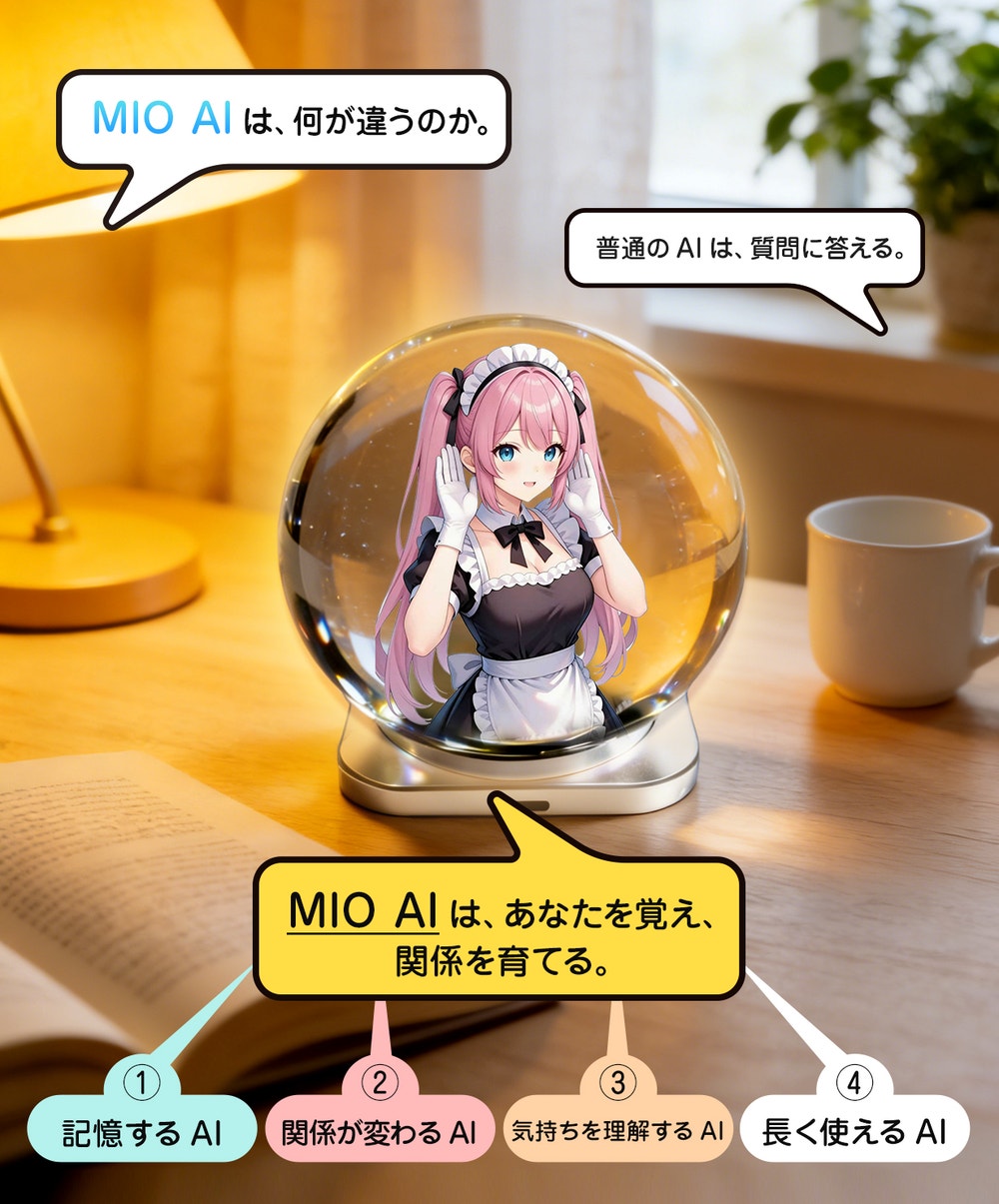
The official page describes MIO AI through four characteristics: "① An AI that remembers," "② An AI whose relationship with you changes," "③ An AI that understands feelings," and "④ An AI built for long-term use." This distinction from a typical question-answering voice assistant is central to the product's pitch.
Long-Term Memory Conversation
MIO AI's core feature is conversation built on long-term memory.
Rather than resetting after each exchange like a typical smart speaker, it's designed to retain details from past conversations and carry them into future ones. The official messaging — "an AI that matters more the more you use it" — reflects a focus on relationship-building over pure convenience.
Mood-Based Expression and Conversation Changes
MIO AI includes what's described as an "affection system" that shifts its expression and conversational tone based on mood and topic. This kind of responsiveness — where the interaction changes based on how often and how you engage — is a direction shared with other conversational AI robots, including Romi and Mia.
Voice Control, Alarms, Memos, Language Learning, and Song Requests
Beyond conversation, several practical features are listed:
- Voice control
- Alarm setting
- Memo function
- Language-learning support
- Song requests, performed as singing
- A simple setup: power on, connect to Wi-Fi, and start talking
- Wi-Fi connectivity used to accumulate conversation history
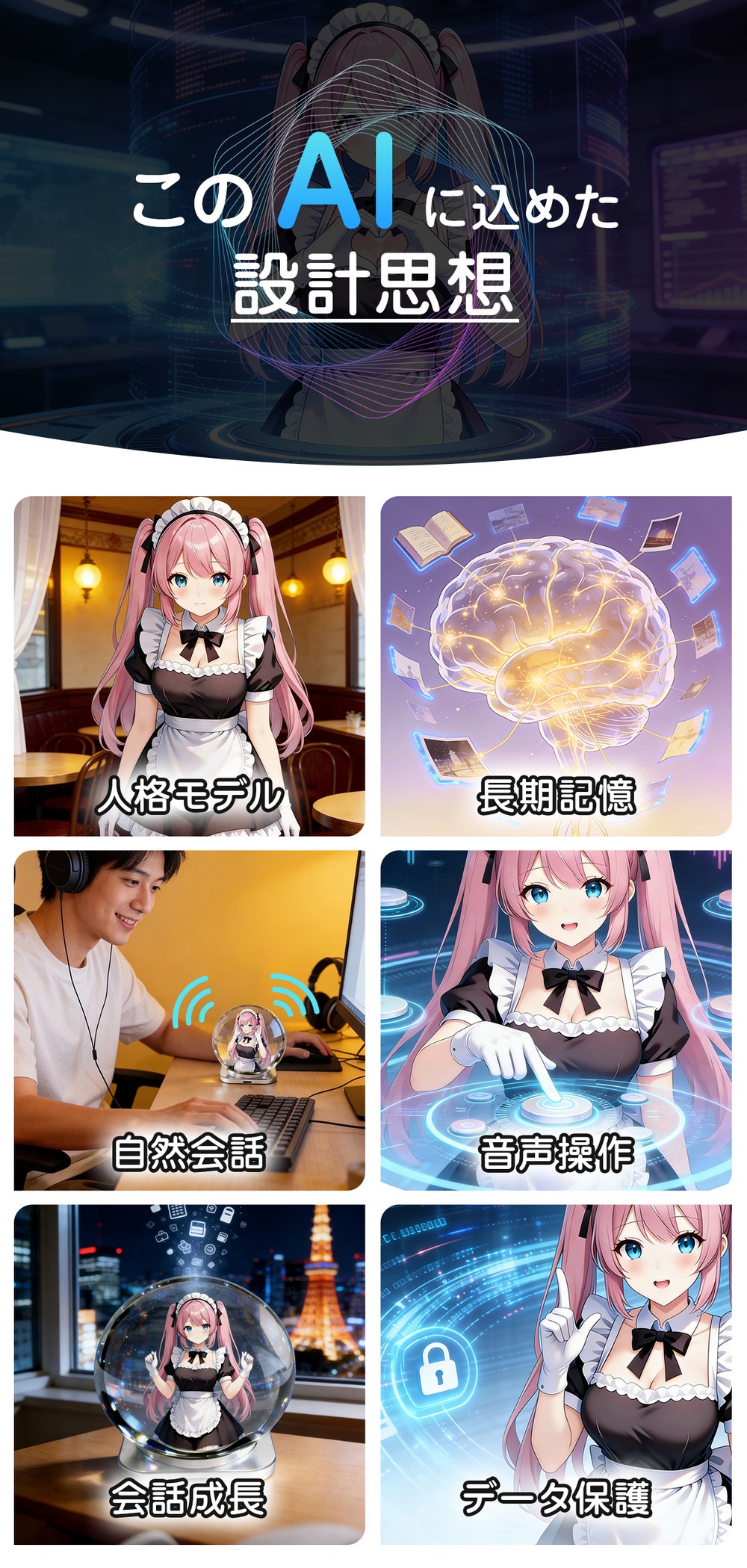
The official page also outlines six design pillars behind these features: "personality model," "long-term memory," "natural conversation," "voice control," "conversational growth," and "data protection." Pairing a growing, memory-based experience with an explicit data-protection pillar is worth noting for anyone evaluating a long-term-memory AI companion.
That said, details like supported languages, the specific content of the language-learning feature, and the song library aren't described in depth on the Makuake page as of this writing. As a pre-launch product, this is information to watch for as it becomes available.
How It Compares to Gatebox3, CODE27, and WEHEAD
MIO AI is easier to understand alongside devices that "give AI a physical presence" than alongside small pet robots like Mia.
The closest comparison points are Gatebox3, CODE27, WEHEAD, and ROLA One.
| Product | Similar point | Difference from MIO AI |
|---|---|---|
| Gatebox3 | Displays a character inside a transparent housing to create a "living with an AI character" experience | Gatebox3 centers on a character shown on a display. MIO AI's glass housing itself is the presence, with no character display |
| CODE27 | Displays 3D characters in a hologram-style box for AI conversation | CODE27 leans toward a digital figure box. MIO AI is more palm-sized and practical, suited to a desk or nightstand |
| WEHEAD | Gives AI a "face" for more direct, face-to-face conversation | WEHEAD centers on screen-based facial display. MIO AI has no face display, relying instead on voice and expression cues (such as light or motion through the glass) |
| ROLA One | A realistic upper-body sculpture for face-to-face AI companionship | ROLA One is a high-priced silicone sculpture. MIO AI, starting at 35,800 yen, is priced for far more casual, everyday use |


In this product category, hardware and price aren't the only things that matter — conversational AI accuracy, where memory is stored, cloud service continuity, and support all shape the long-term experience. As a crowdfunding-stage product, it's worth watching for post-launch update history and support channels for MIO AI as well.
FAQ
When will MIO AI ship?
According to the Makuake project page, delivery is expected by the end of November 2026. As with any crowdfunding project, manufacturing and shipping status can shift this timeline.
Can I choose the size or color of MIO AI?
The Makuake page doesn't list exact dimensions or color options as of this writing. It's known to be palm-sized with a rounded, reinforced-glass design, but detailed specifications will need to wait for further disclosure.
Does MIO AI support Japanese conversation?
Jinwa Shoji Co., Ltd. is a Japan-based company running this campaign on Makuake, a Japanese crowdfunding platform, so Japanese conversation is presumably a core assumption. Actual conversational accuracy and range of expression are best confirmed through post-launch reviews.
Is there a monthly fee?
The Makuake page doesn't clearly state a monthly fee. Products with long-term memory and cloud connectivity often carry some form of subscription cost for data usage or cloud storage, so it's worth checking the Makuake page or future official announcements before backing.
What are the risks of backing a crowdfunding campaign?
On platforms like Makuake, funding outcomes, manufacturing progress, and unforeseen issues can delay delivery or lead to partial spec changes. Unlike ordinary retail, backing is a support purchase for a project, not an immediate guaranteed purchase — worth keeping in mind when deciding whether to back it.
Specifications Summary
| Item | Detail |
|---|---|
| Product name | MIO AI |
| Developer/Seller | Jinwa Shoji Co., Ltd. (Bunkyo, Tokyo) |
| Sales format | Makuake (crowdfunding / support purchase) |
| Campaign period | August 21 – October 30, 2026 |
| Expected delivery | End of November 2026 |
| Body material | Reinforced glass, high-sensitivity microphone, quality speaker |
| Size | Palm-sized (exact dimensions undisclosed) |
| Main features | Long-term memory conversation, mood-based expression/conversation changes, voice control, alarm, memo, language-learning support, song requests |
| Connectivity | Wi-Fi (used to accumulate conversation history) |
| Price (early bird) | 35,800 – 44,800 yen; 2-pack bundle 75,800 yen |
| Funding goal | 199,999 yen |
| Caution | Crowdfunding format carries shipping/spec-change risk; detailed specs are still pending official disclosure |
How MIO AI Differs From Mia, the Chatty Cat Robot
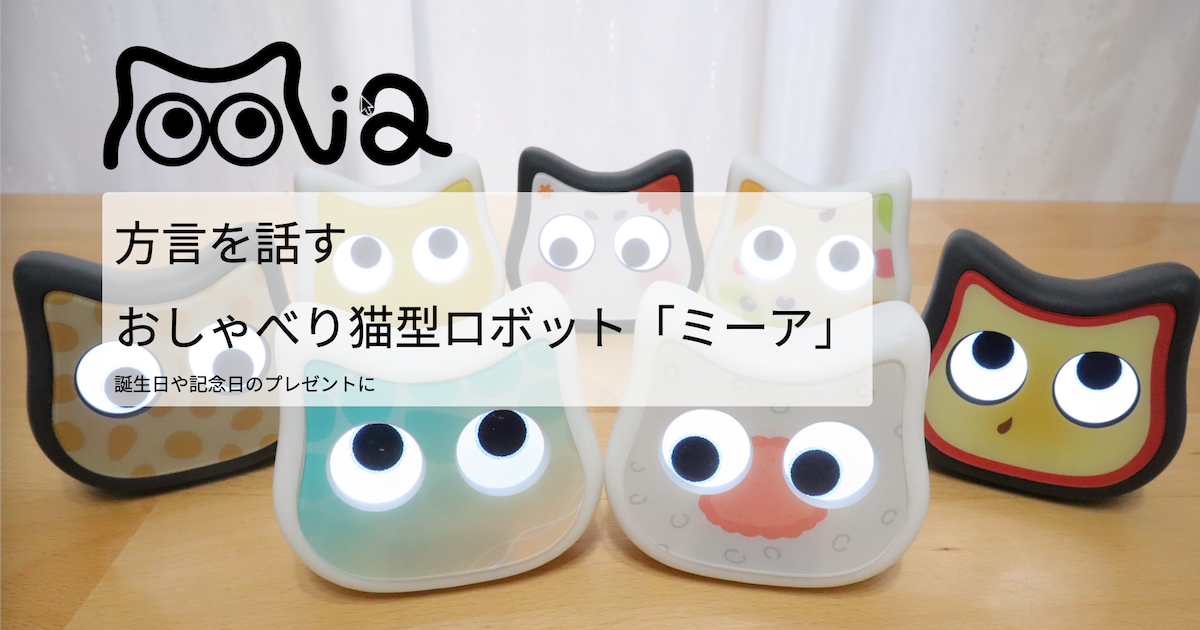
MIO AI's glass-orb design and Mia's cat-shaped robot are quite different in both look and approach. Both share the idea of "a presence that responds when you talk to it," so if you're looking for a conversational AI gadget, it helps to compare their design and price.
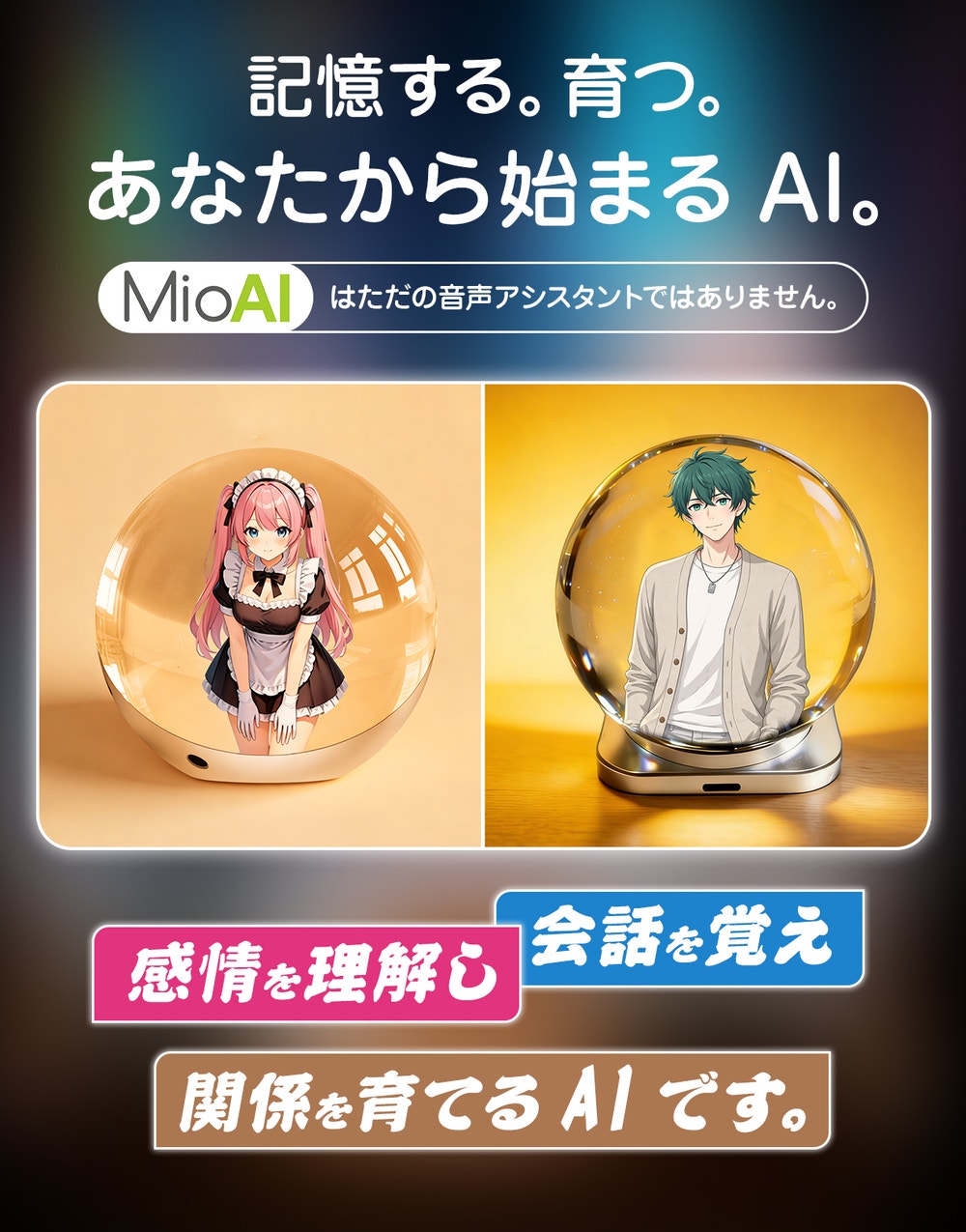
Where Mia builds familiarity through its cat form and regional Japanese dialects, MIO AI leans on the world of an original character glowing inside the glass to sell the idea of "a growing relationship." Neither is really a purely utilitarian voice assistant — both lean into character and presence as part of the design.
| Comparison | MIO AI | Mia |
|---|---|---|
| Look/Form | Reinforced-glass, crystal-ball/orb-like design | Cat-shaped, compact and easy to place |
| Main features | Long-term memory conversation, mood-based expression/conversation changes, language-learning support | 47 Japanese regional dialects, expressions, voice interaction, Google Calendar integration, weather notifications, 15 English characters |
| Sales format | Makuake crowdfunding (delivery expected end of November 2026) | Available now |
| Placement | Desk, nightstand, etc. | Desk, shelf, living room, bedroom |
| Price range | Early bird from 35,800 yen (final price may vary) | From 9,800 yen including tax |
| Best for | People who want to try a new form of AI partner early | People who want an affordable cat-shaped companion to talk to right away |
Summary
MIO AI is a crystal-ball-like AI partner from Jinwa Shoji Co., Ltd., built with a reinforced-glass body and currently running as a Makuake crowdfunding campaign.
Centered on long-term memory conversation and mood-based expression changes, it pitches a relationship-building concept summed up as "an AI that matters more the more you use it." The most natural comparisons are AI character devices like Gatebox3, CODE27, WEHEAD, and ROLA One — devices that give an AI character physical presence. Within that group, MIO AI stands out by putting the presence in the glass housing itself, rather than a character on a screen.
At the same time, this is still a Makuake crowdfunding-stage product as of this writing, and several details — exact dimensions and color, whether there's a monthly fee, and data storage conditions — remain pre-launch information. Anyone considering backing it should check the latest details and reward terms on the Makuake page directly.
If you're looking for an affordable, cat-shaped robot that's ready to talk right now, Mia is worth considering as well.
👀 You may also like:
👉 2026 Guide: AI Pet Robots for Elderly Loneliness – A Comparison of 10 Companion Robots
👉 2026 Edition: 9 Recommended Pet Robots Under $150 – Cheap, Cute, and Healing Models
👉 Monthly and Maintenance Costs of Pet Robots: Moflin, LOVOT, Mia, and More
👉 Mia – Your Chatty AI Cat Companion Robot with 100+ Expressions