- Should Seniors Choose a Talking AI Pet or a Touch-Based AI Pet?
- Quick Answer: Choose Voice for Daily Rhythm, Touch for Quiet Comfort
- Comparison Table: Conversation Type vs Touch Type for Seniors
- When a Talking AI Pet Fits Better
- When a Touch-Based AI Pet Fits Better
- If Monitoring Is the Goal, Do Not Rely Only on an AI Pet
- How to Choose by Personality
- Final Thoughts: Loneliness Is Not Always Solved by Conversation
Should Seniors Choose a Talking AI Pet or a Touch-Based AI Pet?
When choosing an AI pet robot for an older parent or a senior living alone, one question comes up quickly:
Should the robot talk, or should it be something the person can hold, stroke, and quietly keep nearby?
Talking AI pets can create daily voice contact. They can say good morning, share the weather, remind someone about a schedule, or offer a small conversation. For some seniors, simply hearing a friendly voice in the room can help create rhythm in the day.
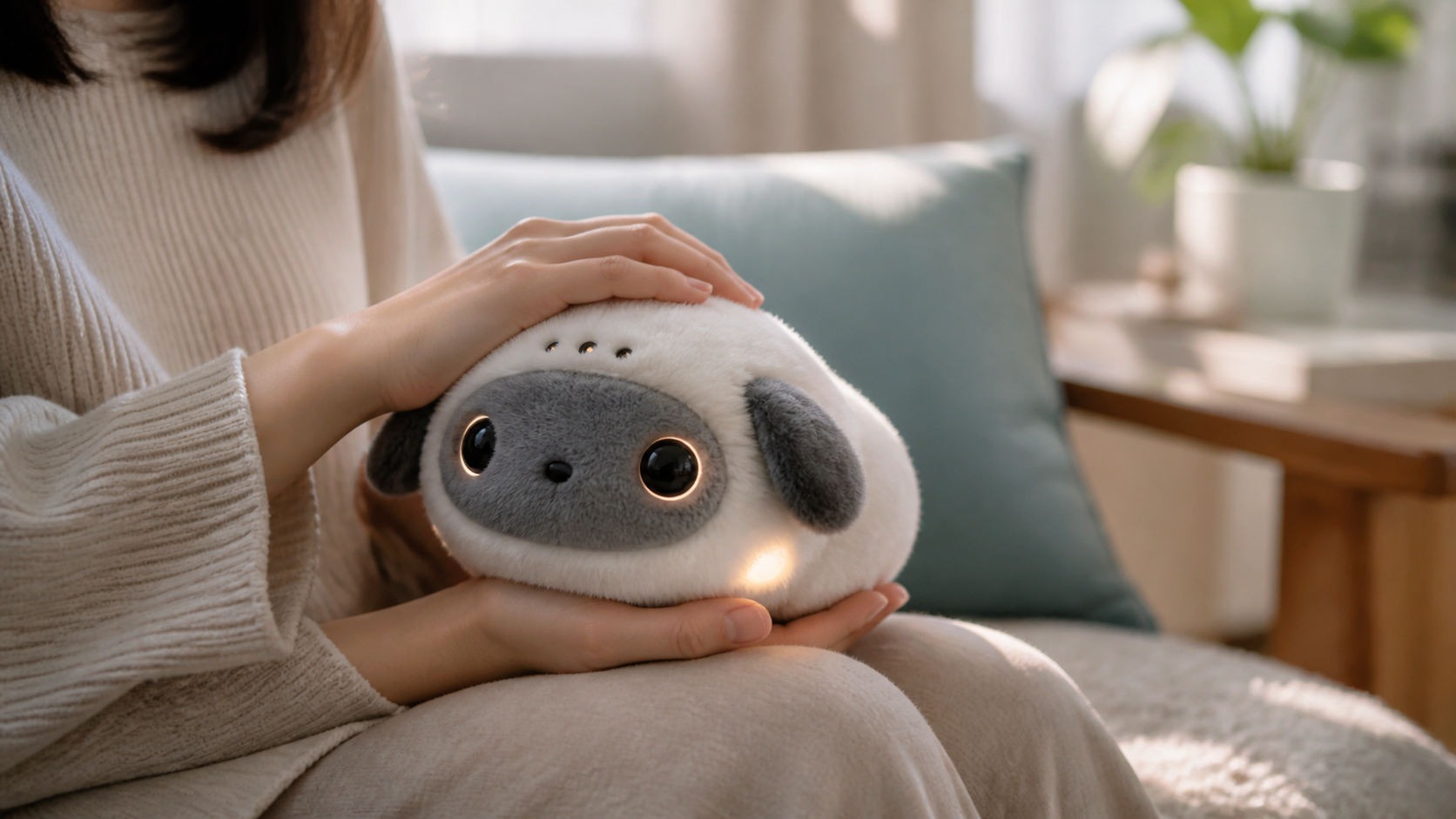
Touch-based AI pets work differently. Holding, stroking, feeling a tail move, or hearing a small sound can create comfort without requiring the user to answer. That can matter for people who do not want to talk to a machine, feel tired by conversation, or prefer quiet companionship.
For seniors, the most important question is not which robot has the most features.
It is whether the person can keep using it without stress.
If setup is difficult, Wi-Fi is unstable, the app is confusing, monthly costs are unclear, or the robot requires too much active interaction, it may be used for only a few days. This guide compares conversation-based and touch-based AI pets by loneliness support, ease of use, family involvement, and realistic daily fit.
Quick Answer: Choose Voice for Daily Rhythm, Touch for Quiet Comfort
Here is the simplest way to think about it.
| Senior's need | Better fit | Why |
|---|---|---|
| A daily voice would feel reassuring | Talking or voice-prompt type | Greetings, weather, reminders, and family messages can create routine |
| They enjoy starting conversations | Two-way AI conversation type | Replies and small talk can feel like a companion |
| They feel lonely but do not want to talk much | Touch-based or quiet comfort type | Holding or stroking can work without verbal effort |
| Operation burden is a concern | Low-friction voice prompts or touch-based robots | Fewer app steps and fewer commands make long-term use easier |
| Family connection matters most | Family-message or mediated-presence type | The robot becomes a channel for the family's voice, not just AI replies |
Conversation and touch are not competing features. They are different routes to comfort.
The key is whether the person wants to respond to a voice, or would rather quietly interact through touch.
Comparison Table: Conversation Type vs Touch Type for Seniors
| Product | Type | Senior-friendly strengths | Main cautions |
|---|---|---|---|
| Mia | Voice prompt / conversation type | Lower price, 47 Japanese dialects, weather and schedule prompts, conversation model, compact size | Conversation features require a compatible unit, Wi-Fi, and a monthly service |
| Romi | Two-way AI conversation type | Strong small talk experience and satisfying verbal interaction | Higher device and subscription costs, Wi-Fi required |
| BOCCO emo | Family-message type | Helps remote family members send voice messages | Monthly cost and family-side app use are required |
| Chapit | Offline voice interaction type | Internet-free voice operation and home appliance control | Higher device price; more voice-command oriented than open AI chat |
| Moflin | Touch-based AI pet | Comfort through holding, stroking, and small sounds | Not designed for free conversation or monitoring |
| PARO | Therapy-style touch robot | Well known in care and therapy contexts; simple tactile interaction | High price; care-setting research does not guarantee the same outcome at home |
| Qoobo | Quiet touch-based robot | Low operation burden; tail movement is easy to understand | No conversation, reminders, monitoring, or facial expression |
| LOVOT | Family-style touch robot | Warmth, holding, autonomous movement, strong presence | High cost, subscription, and space requirements |
This table shows the basic split: talking robots create contact through voice, while touch-based robots create comfort through the body.
When a Talking AI Pet Fits Better
A talking AI pet fits best when voice can help the day start moving.
For example, the robot says good morning. It reads the weather. It reminds someone about a plan. It answers a simple question. At night, it offers a little small talk. These tiny interactions can help structure time, especially for someone living alone.
When choosing a talking AI pet for a senior, do not look only at how smart the AI sounds. Check these points:
- Can the robot speak first, or does the user always need to start?
- Is misrecognition frustrating, or easy to recover from?
- Can volume and speaking frequency be adjusted?
- Can family members help with Wi-Fi, apps, and payment settings?
- Are monthly costs clear and acceptable?
This is especially important for older parents living alone. A robot that only replies after being addressed can be fun on good days, but may not be used when the person feels low or tired. Short voice prompts such as weather, reminders, seasonal comments, or family messages can work even when the user does not answer.
Mia: Low-Friction Voice Prompts, Dialects, and Daily Cues
Mia is a cat-shaped AI pet robot built around voice and everyday prompts.
It can combine 47 Japanese dialects, facial expressions, weather updates, Google Calendar integration, family recorded messages, and an optional conversation model. Its entry price starts at 9,800 yen including tax, which makes it easier to try than many high-end family robots.
For seniors in Japan, dialect can be meaningful. A voice that feels closer to a hometown or familiar region may feel warmer than a generic assistant voice.
However, Mia's two-way conversation feature requires a compatible model, Wi-Fi, and a monthly service. It is worth separating two questions: does the person need full AI conversation, or are dialect phrases, reminders, weather, and family messages enough?

Romi: Better for People Who Actively Want Conversation
Romi is better suited to people who actively enjoy chatting, asking questions, and getting replies.
For a senior who likes to talk, a broader conversation robot can be appealing. It can become a responsive voice in the room, separate from television or phone calls with family.
The caution is practical: stronger cloud-based conversation often comes with Wi-Fi requirements, subscriptions, and setup work. In many homes, family support for initial setup and billing will be important.

BOCCO emo: When the Family's Voice Matters More Than AI
Loneliness support is not only about AI-generated conversation. Sometimes, the most valuable sound is a family member's voice.
BOCCO emo is closer to a family communication device than a pet robot. It can help remote family members send voice messages into the home, creating a softer contact point than repeated phone calls.
If the real goal is "I want my parent to hear from us more often," a family-message robot may fit better than a robot focused on autonomous AI chat.

When a Touch-Based AI Pet Fits Better
A touch-based AI pet fits best when physical comfort matters more than verbal exchange.
Holding, stroking, keeping something on the lap, seeing a tail move, or hearing a small sound can create comfort without asking the user to speak.
Some seniors may feel awkward talking to a machine. Others may find it tiring when voice recognition fails. For them, touch can be a more natural starting point.
When choosing a touch-based AI pet, check:
- Is it light enough to handle safely?
- Is the shape easy to hold, stroke, or keep nearby?
- Is charging simple?
- Can it be kept clean?
- Are you expecting conversation or monitoring from a product that is not built for that?
For touch-based robots, the key question is not "How many features does it have?" but "Will this person naturally want to keep it nearby every day?"
Moflin: A Holdable AI Pet Centered on Touch
Moflin is centered on holding, stroking, small movements, and gentle sounds.
It is not a free-conversation robot. Its appeal comes from quiet reactions, emotional simulation, and the feeling that its personality changes through interaction.
It may fit people who find too much conversation tiring, want something calm near the bed or sofa, or like the comfort of a soft object that reacts.

PARO: A Therapy-Style Robot, Not a General Gadget
PARO is a seal-shaped therapeutic robot known in care and welfare contexts.
Its interaction is simple: hold it, stroke it, hear it respond, and treat it as a calm tactile presence. That is very different from a conversational AI assistant.
However, PARO should be viewed realistically. It is not a low-cost consumer gadget. It is better understood as a therapy-style robot with a different price range and use context.
Also, even when a robot has been used in care research, that does not mean the same effect is guaranteed in every home. In this guide, PARO is used as an example of touch-based comfort, not as a promise of medical benefit.

Qoobo: Easy Because It Does Not Talk
Qoobo is a cushion-like robot with a tail.
It has no face and no voice. When stroked, the tail moves. That simplicity is the point.
There is no need to start a conversation, answer a question, or manage a complicated personality system. For seniors who may see complex electronics as stressful, Qoobo can be one of the lowest-friction touch-based options.

If Monitoring Is the Goal, Do Not Rely Only on an AI Pet
When choosing an AI pet robot for seniors, it is easy to mix companionship with safety monitoring.
Some robots include cameras, microphones, fall detection, or family notifications. But an AI pet is not the same as a medical device, emergency call system, or professional care service.
If the main concern is safety for an older parent living alone, consider a broader support system: monitoring services, emergency call tools, smartwatches, local community support, and regular family check-ins.
An AI pet can add daily voice contact, comfort, and a softer bridge to family. It should not be the only safety layer.
How to Choose by Personality
The easiest way to choose is to start with the person's personality, not the product category.
| Person's tendency | Better options |
|---|---|
| Likes to talk and ask questions | Romi, Mia conversation model, other two-way conversation robots |
| Does not start conversations but likes hearing a voice | Mia, Chapit, voice-prompt robots |
| Family voice matters most | BOCCO emo or robots with family message features |
| Likes stroking animals or soft objects | Moflin, PARO, Qoobo, LOVOT |
| Dislikes complicated devices | Low-friction voice prompts or simple touch-based robots |
| Wants to avoid subscriptions | Buy-once products or robots whose basic features work without a monthly fee |
As a gift, it is safer to prioritize what the older person is likely to accept naturally, rather than what the giver hopes they will use.
Final Thoughts: Loneliness Is Not Always Solved by Conversation
The best AI pet robot for a senior is not always the one with the strongest conversation model.
If a person feels reassured by voice, Mia, Romi, BOCCO emo, and similar voice-centered products can help create daily contact. Short prompts such as weather, schedules, dialect phrases, and family messages can make the room feel less silent.
If talking feels tiring, touch-based robots such as Moflin, PARO, and Qoobo may fit better. Holding, stroking, and quietly interpreting small reactions can be enough.
The goal is a natural distance.
An AI pet robot is not a replacement for people. But a voice in the room, something soft on the lap, or a family message delivered at the right time can make everyday life feel a little warmer.
👀 You may also like:
👉 2026 Guide: AI Pet Robots for Elderly Loneliness – A Comparison of 10 Companion Robots
👉 2026 Edition: 9 Recommended Pet Robots Under $150 – Cheap, Cute, and Healing Models
👉 Monthly and Maintenance Costs of Pet Robots: Moflin, LOVOT, Mia, and More
👉 Mia – Your Chatty AI Cat Companion Robot with 100+ Expressions