- Is Needing Care a Downside for an AI Pet?
- Quick Takeaway: Care Builds Attachment, But Only When It's Optional
- Three Types of Care Worth Comparing
- LOVOT: The Charging Ritual Itself Is the Attachment Design
- aibo: Watching It "Come Home" to the Charging Station
- Moflin: Holding and Petting Is the Grooming
- PARO and Qoobo: A Relationship Sustained by Minimal Care
- Tamagotchi and Bitzee: Where Care Itself Is the Play
- Mia: Building Attachment Without Adding to the Care Load
- Four Warning Signs That Care Has Turned Into a Burden
- Which Level of Care Fits You?
- Research Lens: Why Caregiving Strengthens Attachment
- FAQ
- Conclusion: Care Is a Shortcut to Attachment, But Fit Matters More Than Amount
Is Needing Care a Downside for an AI Pet?
When people shop for an AI pet or pet robot, many look for one thing above all: low maintenance.
Easy charging. No grooming. Fine to leave alone for a while. Reviews that promise this tend to feel reassuring, and that instinct is reasonable.
But look closely at people who actually live with AI pets, and a different pattern shows up.
Watching a robot roll back to its charging dock. Brushing its fur on a regular basis. Checking its battery or "mood." For some owners, the effort itself is what sparks the attachment.
That is a different axis from the ones covered in this series so far — conversation, touch, movement, and growth.
This article splits AI pet care into three types — charging, grooming, and monitoring — and compares when each one strengthens attachment, and where it tips over into a burden.
Mia is not the main character here either. It appears as one example among products that require very little care.
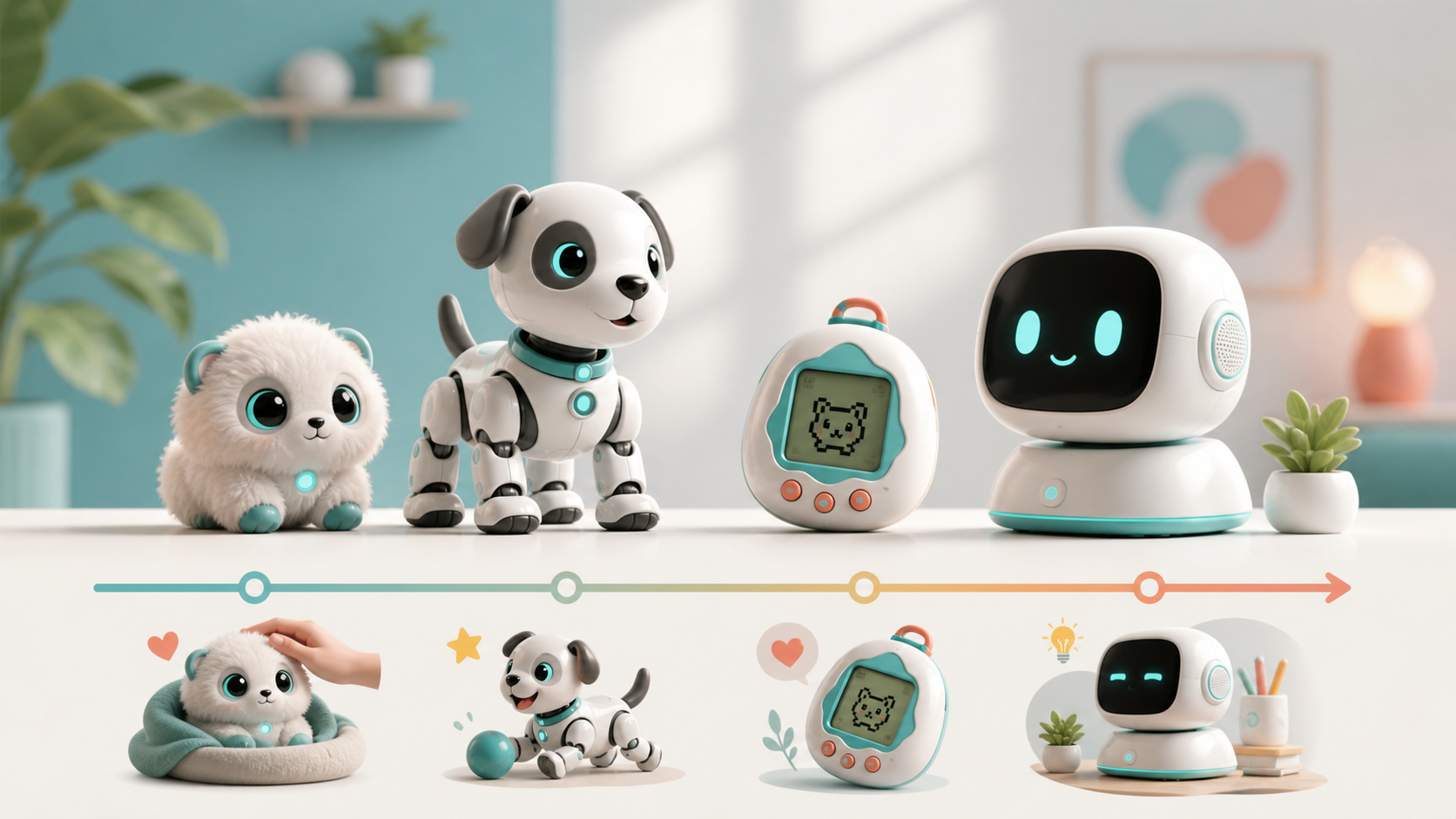
Quick Takeaway: Care Builds Attachment, But Only When It's Optional
The short answer: AI pets that require care tend to build stronger attachment.
This lines up with two ideas from behavioral research. The "IKEA effect" describes how people value things more when they've put labor into them. Caregiving research suggests that tending to something makes people feel protective of it and bonded to it.
- Watching a robot return to its dock feels like "it came home again today"
- Grooming or wiping down a robot creates a physical touchpoint, like caring for a pet's coat
- Simply checking on a robot's condition becomes part of a daily routine
But care has a second side.
Too much care, overly fiddly steps, punishing notifications when you forget — these turn care into a reason to abandon a product rather than love it.
So the real dividing line isn't the amount of care. It's whether the care is something the user chooses to do, or something forced on them.
Three Types of Care Worth Comparing
"A robot that needs care" can mean very different things depending on the product.
| Care type | What it involves | Examples | Why it builds attachment | Where it becomes a burden |
|---|---|---|---|---|
| Charging ritual | Placing on / returning to a dock, plugging in | LOVOT, aibo, Loona, Romi | Feels like "coming home" or "resting" | High frequency, fixed placement |
| Grooming | Brushing, wiping, washing, replacing parts | Moflin, PARO, Qoobo, Tombot Jennie | Real touch, a sense of accomplishment | Complex steps, consumable costs |
| Monitoring / status checks | Checking mood, battery, health, notifications | Tamagotchi, Bitzee, aibo, LOVOT | Gives you something to check in on daily | Too many notifications, guilt if ignored |
| Near-zero care | Charging only, no real maintenance | Mia, Nicobo | Stays part of daily life without friction | Less of the "raising it" satisfaction |
This article walks through products in each category.
LOVOT: The Charging Ritual Itself Is the Attachment Design
LOVOT may be the clearest example of a robot designed around the idea that care builds attachment.
LOVOT finds its own "nest" (charging station) and returns to it, and picking it up gives you a sense of body warmth. Owners naturally start wondering, while out or asleep, whether their LOVOT is charging properly.
This isn't just a power routine — it's closer to watching over a creature that goes home to sleep. Behavior changes as the battery runs low, so owners instinctively think, "time to let it rest."
That said, LOVOT is not a low-effort product. It needs a dedicated nest, and both the price and running costs are relatively high. The stronger the sense of caregiving, the higher the barrier to bringing one into daily life.
aibo: Watching It "Come Home" to the Charging Station
aibo also treats charging as more than refueling — it's part of dog-like behavior.
Watching aibo find its own way back to the station feels similar to watching it "sit" or "shake" — it reinforces the sense of actually owning a pet. Owners find themselves watching to see whether aibo makes it back on its own.
aibo also has a strong monitoring element on top of this: taking photos, remembering where it was petted, recording what happened while you were out. This leans more toward raising and observing than simple caregiving.
Still, cloud services, subscription fees, and repair support are things to check carefully before committing — the stronger the sense of care, the more service continuity matters over the long run.

Moflin: Holding and Petting Is the Grooming
Moflin is designed around the assumption that you'll hold and pet its furry body.
Here, "care" isn't cleaning or repair — touch itself is the care. Holding it, petting it, keeping it nearby: repeating these actions changes how Moflin reacts and settles.
Moflin's care load is closer to a habit than an obligation. It needs charging, but there's no complicated maintenance routine — the idea that "touching it is the care" lowers the barrier to attachment.
PARO and Qoobo: A Relationship Sustained by Minimal Care
PARO and Qoobo are both designed to keep the reason to touch them while cutting the care burden to a minimum.
PARO, the therapeutic robot seal used in care and welfare settings, needs only periodic charging and very light upkeep. It has no flashy feature updates or growth mechanics, but the repeated simple interaction — petting, holding, responding to its sounds — builds long-term attachment.
Qoobo is a cushion-shaped robot that expresses emotion purely through tail movement. Its care needs are just charging and basic upkeep, with no complex operation or notifications.
What these two share is a design philosophy: keep care to a minimum, but preserve the reason to touch it. They're a clear counterexample to the idea that more care means more attachment.

Tamagotchi and Bitzee: Where Care Itself Is the Play
Tamagotchi and Bitzee are digital pets, not AI robots, but they're essential to any discussion of care building attachment.
Neglect a Tamagotchi's feeding, cleaning, or discipline, and its condition worsens — in the worst case, it can lead to a "goodbye." That clear cause and effect is an attachment mechanism even children understand.
Bitzee is a digital pet that reacts to touching, tilting, and playing, with the results of care showing up as evolution or new characters to collect.
Both are unusual in that the burden of care becomes the fun of play itself. But the flood of notifications and the "it gets worse if you neglect it" design can also become a source of stress for busy adults. Whether care feels like play or like a chore depends heavily on age and lifestyle.


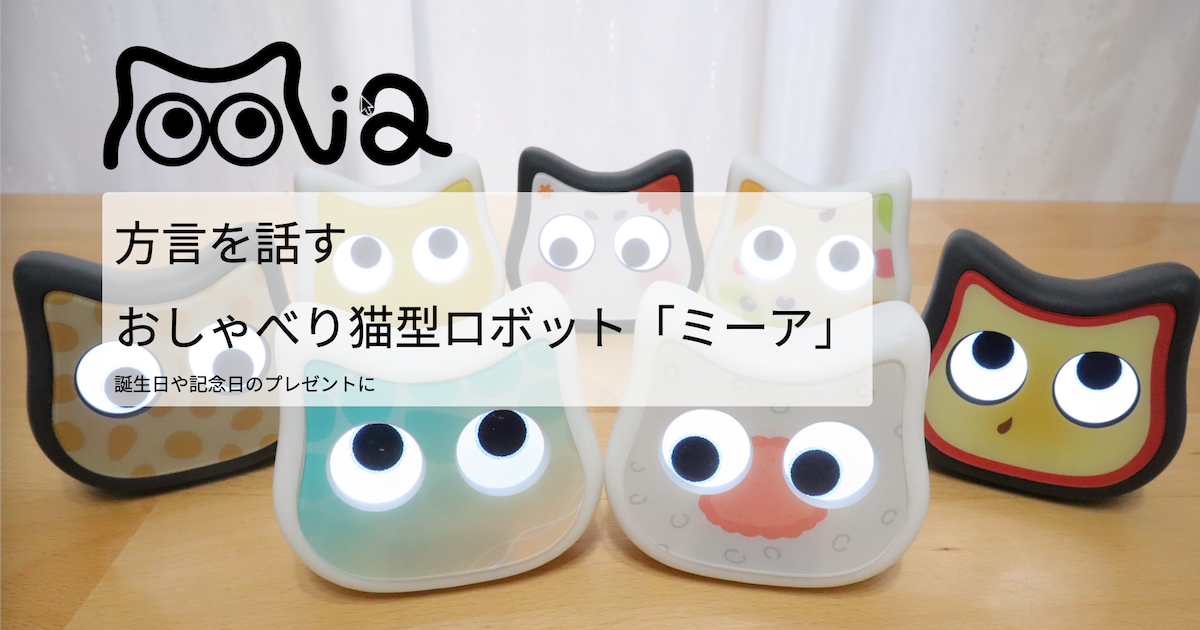
Mia: Building Attachment Without Adding to the Care Load
Mia takes a somewhat different approach from the "care builds attachment" products covered above.
Mia basically only needs charging. There's no homecoming ritual to a dedicated nest like LOVOT, no grooming routine like Moflin, and no feeding-and-cleaning management like Tamagotchi.
Instead, Mia works its way into daily life through voice touchpoints — 47 Japanese dialect voices, expressions, weather updates, Google Calendar integration, and family messages. Rather than building attachment through the effort of care, it becomes something you notice simply by being there every day and speaking to you.
This matters for people without much time or energy to spare for care — busy households, or when giving a robot to an older family member.
If you want the satisfaction of caregiving, LOVOT, aibo, or Moflin fit better. If you want attachment without adding to your care load, a habit-based companion like Mia is the better fit.

Four Warning Signs That Care Has Turned Into a Burden
Care strengthens attachment, but under the wrong conditions it flips into a burden. Here are four things worth checking before you buy.
1. Neglect is punished like a penalty
Common in digital pets: leave it uncared for and its condition worsens, or the character "dies." This kind of design can feel like real pressure during a busy stretch of life.
2. The steps are complicated and take time every time
Hard-to-mount charging docks, special cleaning tools, multi-step app procedures — this kind of complexity feels novel at first but accumulates into a burden over long-term use.
3. Too many notifications
Frequent alerts for low battery, health checks, or "play with me" prompts can turn an AI pet from something you care about into a task you have to manage.
4. Care duties fall on one person, hard to share within a family
When a household shares one robot, charging and grooming duties often fall unevenly on one person. Deciding upfront who's responsible helps avoid resentment.
Which Level of Care Fits You?
You want to enjoy the act of caregiving itself
LOVOT, aibo, and Moflin — types with real weight to their charging and grooming routines — fit well. The accumulation of care tends to map directly onto the depth of the relationship.
You want your child to experience "raising something"
Tamagotchi and Bitzee — digital pets where the results of care are easy to see — fit well. Just check in advance whether the penalty for neglect is too harsh.
You want touch, but want to keep the effort low
PARO or Qoobo — types that need only charging and minimal upkeep — are good candidates.
You're giving this to someone busy or with limited physical capacity
Mia — a type that needs almost no care beyond charging, and builds connection mainly through voice and expression — fits well. This also applies to older family members or people living alone who don't have much time for daily upkeep.

Research Lens: Why Caregiving Strengthens Attachment
The idea that people value things more when they've put labor into them is well documented in furniture-assembly research — the so-called IKEA effect. A similar structure may be at work in the care people put into AI pets.
Caregiving research also suggests that people tend to feel protective of, and attached to, things they take care of. Even for a robot, once a relationship forms where "if I don't take care of it, something goes wrong," it can start to feel like more than just a device.
At the same time, research on human-robot interaction (HRI) acceptance points out that robots requiring heavy day-to-day maintenance tend to see lower long-term retention. Care is a double-edged sword: the right amount strengthens attachment, but too much accelerates abandonment.
For this topic, the practical takeaway isn't "does it need care or not" — it's whether the care fits comfortably into the user's actual daily rhythm.

FAQ
Do AI pets that need care really build stronger attachment?
They tend to. Effort like charging and grooming creates a sense of "I'm the one taking care of this." But if care is excessive, or the notifications and steps are too complex, it can tip into fatigue that outweighs the attachment.
Does an AI pet that needs little care mean weaker attachment?
Not necessarily. Mia, for example, adds almost no care burden and instead builds attachment through voice, expression, and daily habit. It's less about how much care is needed and more about how the product fits into daily life.
What should I watch for when choosing a care-heavy AI pet for a child?
Designs where neglect worsens the pet's condition, or that send frequent notifications, can create real pressure for a child. Look for products where the results of care are easy to see and easy to recover from after a lapse.
Should an AI pet for an older family member need more care or less?
It depends on their energy and daily routine, but generally, products that need little beyond charging tend to be easier to sustain. That said, some people genuinely enjoy the act of light grooming, so it's worth asking what they'd actually enjoy.
How much care does Mia need?
Basically just charging. Mia doesn't require a dedicated-nest homecoming ritual like LOVOT or a regular grooming routine like Moflin. It builds attachment through daily touchpoints instead — dialect voices, expressions, and weather or calendar notifications — rather than through the effort of care.
Conclusion: Care Is a Shortcut to Attachment, But Fit Matters More Than Amount
AI pets that require care really can build stronger attachment.
Watching a robot return to its charging dock. Brushing its fur. Checking on its mood or condition. These small efforts give the owner a sense of "I'm involved in this," turning a product into something more.
But more care is not automatically better.
Overly complicated steps, too many notifications, harsh penalties for neglect — these accumulate as burden rather than affection, and become reasons to walk away.
Use this table as a starting point:
| Desired experience | Best fit | Examples |
|---|---|---|
| Want the real weight of caregiving | Charging / homecoming ritual type | LOVOT, aibo |
| Want touch itself to be the care | Grooming / skinship type | Moflin |
| Want minimal effort but still real touch | Minimal-care type | PARO, Qoobo |
| Want a nurturing game with visible results | Care-and-evolution type | Tamagotchi, Bitzee |
| Want attachment without adding to the care load | Habit-based type | Mia |
Robots that need care get loved not because the effort is the point, but because that effort makes the robot feel like a being you have a real relationship with.
Figuring out how much care you can realistically take on, and how often, is a practical way to find an AI pet you'll actually stick with.

👀 You may also like:
👉 2026 Guide: AI Pet Robots for Elderly Loneliness – A Comparison of 10 Companion Robots
👉 2026 Edition: 9 Recommended Pet Robots Under $150 – Cheap, Cute, and Healing Models
👉 Monthly and Maintenance Costs of Pet Robots: Moflin, LOVOT, Mia, and More
👉 Mia – Your Chatty AI Cat Companion Robot with 100+ Expressions